Supplement to Part 1: The Smallest Units and Part 1A: The Quon-Continuum Model; companion to the working paper. Downloads: Word · Markdown · analysis scripts (light_part1b.py, fig_light.py). Aspden’s own words on light, with links to every source: Aspden on Light: Source Texts (Word) · Markdown.
What Aspden said about light, the models built to test it and every assumption behind them, what can and cannot yet be judged, and what is left for research
By Doug Westmoreland (project lead: direction and review) and Claude, Anthropic (research and analysis) · Version 1.1, 12 November 2026 (draft 0.5, published as written; 1.1 weights the GRB 090510 limit for each model’s own delay law (L1)) · Supplement to Part 1: The Smallest Units (v1.7) and Part 1A: The Quon–Continuum Model (v1.3) · The numbers are printed by the script light_part1b.py, whose output labels (L1–L15) are quoted in the text.
Drafts 0.1 and 0.2 were each checked by an independent reviewer (Opus, extra effort) who had not seen how they were produced. Draft 0.2 rebuilt the paper around its models and their assumptions, after the project lead pointed out three things:
- the first draft judged Aspden’s theory by models it had not fully set out or justified;
- one of those models predicted gamma rays 41% faster than light, which is evidence against the model rather than against the theory;
- in Aspden’s aether the vacuum’s ε₀ and μ₀, and therefore c, belong to the aether itself.
Draft 0.3 added section 8: extensions of the theory that could make it work, marked as proposals and kept apart from what Aspden said, at the project lead’s request that the analysis leave room to improve his theory as well as test it. Draft 0.4 applies the second review. It:
- judges Aspden’s 1969 formula within the range he claimed for it;
- marks every result that depends on a separate vacuum term;
- adds the continuum’s response as assumption S12;
- states the central dilemma in general form;
- replaces an averaged relativistic estimate with an exact one;
- corrects several attributions and quotations.
Draft 0.5 applies a third independent review, of section 8. It:
- shows that two apparent fits in section 8.2 are definitions;
- corrects the shear-wave and lattice-discreteness results;
- adds a test of Aspden’s 1969 formula by vacuum Cherenkov radiation;
- records one encouraging result: the gyroscopic drift of the two frames carries exactly the magnetic energy of a wave.
Summary
-
Light is the test that matters most for Aspden’s aether. He says his lattice of quons is Maxwell’s displacement current, and that the vacuum’s permittivity ε₀ is the lattice’s own response. If the aether cannot carry light, it cannot be the medium of electromagnetism.
-
What any aether must do can be stated without a model (section 2). In empty space it must give the same ε₀ and μ₀, and so the same c, for radio waves and for gamma rays of 1.4 PeV: the same to 3 × 10⁻¹⁸ between keV and GeV photons, and the same in every direction to about 10⁻¹⁸. Photons of 511 keV have been timed directly, at 0.995 ± 0.005 of c.
-
This is hard for an aether made of charges with mass. Charges with mass cannot keep up with fields that change faster than their natural frequency. That is why the refractive index of every material falls to 1 for X-rays and gamma rays. If ε₀ is the response of quons with mass, the quons must follow a gamma ray’s field as fully as a radio wave’s. Aspden saw the difficulty himself: if the medium has "a related inertial property, then such a wave must eventually suffer frequency dispersion" (1986/87).
-
We built models and list every assumption in them (section 4). These are shared by all of them:
- small displacements obeying Newton’s law, with Aspden’s quon mass;
- the continuum moving as a rigid frame;
- Maxwell’s μ₀ and Faraday’s law taken as given;
- light as a small disturbance riding on a fixed orbit.
Two further assumptions are open choices:
- what pulls a displaced quon back: the field of the displaced lattice, which is what Coulomb’s law gives, or a spring of its own, as Aspden wrote in 1969;
- whether the lattice adds to a separate vacuum term or is that term, which is Aspden’s view.
Their four combinations all fail, each in a different place (section 5 and Figure 1).
- Two add a separate vacuum term his theory does not have. Their failures, including gamma rays 41% faster than radio waves, count against those models, not his theory.
- One is Aspden’s own 1969 formula. Within the range he claimed for it, it makes blue and red light travel at different speeds, 1.5 million times more than the measurement he quoted allows.
-
What follows is conditional. Within the shared assumptions no version of the lattice carries light. A model that works would have to drop at least one of them. Three routes do:
- his self-tuning medium, which is not linear (his remedy for dispersion);
- his "phase-lock" between the orbits, which is not a Coulomb force (he used it for other effects, not for light);
- the project lead’s proposal that the relative motion of the two frames, which Aspden identified with c, carries light, rather than light being a disturbance riding on a fixed orbit.
None of them is written as equations, by him or by us. So whether his aether can carry light is open, not settled.
-
What can be judged now:
- his 1969 formula, within the range he claimed for it: colours travel at different speeds;
- the dual displacement, within linear response: counter-moving charges pushed by the wave add to the lattice’s response, and muons tied to the quons by momentum balance cancel at most 0.02% of their dipole;
- two of his statements taken together: that the lattice is the vacuum’s permittivity, and that the counter-displacement stops at the pair-creation frequency. Together they leave gamma rays above 511 keV with no linear lattice to carry them. His only alternative, "another mechanism" (1969), has no equations.
Each of these fails against observation, or leaves a gap his texts do not fill.
-
What holds:
- Aspden saw the real difficulty clearly and quoted the right test of it.
- His orbit equation is exactly the plasma-oscillation equation of his medium, so the orbit he postulated is consistent with Coulomb’s and Newton’s laws.
- His 1960 "critical field" for a light wave is exactly half the critical field of quantum electrodynamics. The two agree in scale, not in physics, and his value has not been reached in any laboratory.
-
Room to improve the theory (section 8). Four extensions are proposed, each marked [P] and kept apart from what Aspden said:
- the aether as the source of ε₀ and μ₀;
- phase-locked orbits whose angular momentum takes part in the response;
- light as a sound-like shear wave of the lattice, as in his own formula c = √(P/ρ);
- ε_r and μ_r of matter as matter’s change to the aether.
First results show what each extension must overcome.
- Shear waves. Aspden suggested (1980) that the lattice’s rigidity comes from the Coulomb forces between quons. Computed exactly, these give shear waves at 0.22–0.28c, a ratio fixed by his fine-structure chain, and they leave the simple cubic lattice unstable (Part 1, U38). Such a wave has no macroscopic electric field by Coulomb’s law, and with Faraday’s law it is slowed to about 0.003c for visible light.
- Magnetic energy. One result is encouraging. If the phase-lock acts gyroscopically, the frames’ sideways drift carries kinetic energy equal to Maxwell’s magnetic energy at every low frequency, rising and falling with the wave as magnetic energy does. That is close to Aspden’s own description of a wave’s magnetic energy.
-
Open questions (section 10). First of all: build the extensions of section 8 in equations and test each against the observations of section 2, keeping Aspden’s successes (the fine-structure chain and the orbit at the Compton frequency).
1. Why light is the test that matters most
Aspden’s quons are not an optional decoration of his theory. He says they are Maxwell’s displacement current:
- "the electric field of the charge e has, at least in the main body of the space medium where there are charges q, been cancelled by displacement of this electrical medium. Here then is the basis for the displacement currents we associate with Maxwell’s theory" (Physics Unified, 1980, ch. 2; The Physics of Creation (POC), 2003, ch. 6, keeps the last sentence);
- "An electromagnetic wave is a propagated disturbance of the lattice structure formed by the q charges" (Physics Unified, ch. 5);
- the vacuum’s permittivity, the "unity term" in the formula for the speed of light, is the lattice’s own response (Physics without Einstein (PWE), 1969, ch. 6; POC 2003 eq. 6.7).
The numbers of Part 1, including his value of the fine-structure constant, come from the same lattice. So how that lattice carries light decides whether the aether he describes can be the medium of electromagnetism.
Aspden quoted the standard himself: "in the true vacuum that we associate with outer space, Warner and Nather have found that the group velocity of light is constant to better than 5 parts in 10¹⁷" (Lecture 10 Appendix, 1986/87).
2. What any aether must do, before any model is chosen
2.1 In empty space
| Observation | What it requires | Size |
|---|---|---|
| GRB 090510 (Fermi, 2009): a 31 GeV photon arrived within 0.859 s of the burst’s keV light, after 7.5 billion years | keV and GeV photons travel at the same speed | Speed difference below 1.9 × 10⁻¹⁸ to 4.8 × 10⁻¹⁸ of c, depending on how it varies with energy (L1) |
| Optical pulses of the Crab pulsar (Warner and Nather 1969, as Aspden cites them) | All colours travel at the same speed | 5 × 10⁻¹⁷ |
| Direct timing of 511 keV annihilation photons (Cleland and Jastram 1951) | Gamma rays travel at c | 0.995 ± 0.005 of c (L1) |
| Photon mass (Particle Data Group) | No cutoff at low frequency | below 10⁻¹⁸ eV |
| Rotating cavities, optical (Herrmann et al. 2009) and microwave (Nagel et al. 2015) | Light’s speed is the same in every direction | about 10⁻¹⁷ and 10⁻¹⁸ |
| Coulomb’s law, from atoms to laboratories | Static fields are not screened | — |
| LHAASO (2021) | Photons cross the Galaxy | up to 1.4 PeV |
In Maxwell’s terms: ε₀ and μ₀ must be the same at every frequency from radio to 1.4 PeV, the same in every direction, and must not screen static charges.
2.2 In matter
In a material, light travels at c/n, with n² = ε_r μ_r. The material’s own charges add to the vacuum’s response.
- At low frequencies the material’s charges follow the field, and n differs from 1. Glass has n ≈ 1.5 for visible light.
- Above their natural frequencies they cannot follow it, because of their inertia. For hard X-rays n differs from 1 by less than about 10⁻⁴ in every material, and for gamma rays above 100 keV by less than about 10⁻⁶.
Aspden’s account of matter is the same: (c/v)² = 1 + φ, where φ is the matter’s term and the "1" is the aether’s own (PWE 1969; POC 2003 eq. 6.7). In his picture the aether is present inside matter, and matter’s response is added to it.
2.3 The central question
If ε₀ is the response of quons with mass, then the quons must keep following the field at gamma-ray frequencies, where the charges of every known material have stopped following it. Otherwise ε₀, and with it the speed of light, would change between radio waves and gamma rays.
Aspden saw this. "If the field medium has a natural threshold frequency and so a related inertial property, then such a wave must eventually suffer frequency dispersion" (Lecture 10 Appendix, 1986/87). His answer was a vacuum that retunes itself to each signal, the dual displacement of section 6.3.
So the question is not whether some model of quons shows dispersion. It is what in his theory keeps ε₀ the same at every frequency.
3. What Aspden says about light
A search of all 719 texts on the site collected every passage on how light travels, why the two frames move at c/2, the dual displacement, gyroscope-like effects, space domains and screening. The compilation is published alongside this paper as Aspden on Light: Source Texts, with a link to every source.
| Topic | Aspden’s words | Source |
|---|---|---|
| What carries light | "Electromagnetic waves are carried by the lattice constituent of space-time." The continuum is ruled out: "the G frame moved in a fixed orbit … Wave disturbance, therefore, no doubt involves displacement of the particle lattice." | PWE 1969, ch. 6 |
| The vacuum’s permittivity | The "unity term" in the refractive index "may itself have the form of (6.33)", the lattice’s own term, with "p₀ … not equal to Ω". Its range: "To be unity, there must be no dependence upon propagation frequency. Thus, p must be very small compared with p₀." | PWE 1969 eqs. 6.23–6.34; POC 2003 eq. 6.7 refers back to it |
| High frequencies | "We are not, therefore, concerned with the problem of wave propagation by the space-time particle lattice, when we analyse effects at frequencies of the order of Ω. Propagation at such high frequencies involves another mechanism. This is the mechanism by which disturbances are propagated through the medium separating the lattice particles." | PWE 1969 ch. 6 |
| What sets c | "the relative velocity between the system of aether particles and the medium constituting the background continuum is assumed to be the speed of light"; "a likely candidate is the relative velocity between the E-frame and the G-frame"; "Thus, indirectly, the speed of light at any position in the vacuum medium depends upon the speed of the bound lattice particles" | The Theory of Gravitation, 1960 (1998 note); POC 2003 ch. 6; Physics Unified ch. 9 |
| The orbit in wave analysis | "To proceed, the fundamental harmonious motion of space-time in its undisturbed state is ignored." | PWE 1969 ch. 6 |
| The aether is a plasma | "a cold neutral ionized plasma"; ω² = 4πN₀e²/m is "a resonant mode" | Essay 13, 1998; POC 2003 eq. 9.17 |
| Magnetic energy | The energy of a wave in free space is exchanged between electric displacement and the kinetic energy of the quons’ lateral motion; "there is no such thing as a magnetic field out there in free space" | Research Note 4/98 |
| The dispersion problem | "if the field medium has a natural threshold frequency and so a related inertial property, then such a wave must eventually suffer frequency dispersion" | Lecture 10 Appendix, 1986/87 |
| The dual displacement | "two charge structures capable of moving through one another in opposite directions … With it comes a solution to the dispersion problem … The frequency at which electron-position [sic] pair creation occurs is the limit frequency beyond which there is no counter-displacement" | Wireless World, 1982 (Lecture 24) |
| What counter-displaces | "the response of the muon energy sea"; "some of the relatively massive muons must be displaced in an opposite sense to provide dynamic balance" | Commentary on 1982a; POC 2003 ch. 9 |
| How much | "at zero frequency the counter-displacement … is wholly balanced"; at radio frequencies "partial, though nearly equal"; K = E/E₁ = (f/f₀)², "E₂ = 0 when f equals f₀" | Lecture 10 Appendix; Tutorial Note 18, 1999; 1984e |
| Self-tuning | "a restoring force rate that adjusts in compliance with the frequency to give perfect resonant response" | Physics Essays, 1991 |
| Signals together | "The field medium is able to respond to one-way propagation and follow changes in frequency of a composite signal because it has to respond momentarily only to one value of the signal rate of change and one value of its strength. It faces a dilemma in trying to respond to two signals travelling through one another in opposite directions." | Lett. Nuovo Cimento, 1983 |
| Electron–positron pairs | "will not obstruct the passage of electromagnetic waves because they have a mutual inertial balance and are collectively neutral in their response to electric fields" | 1984e |
| Phase-lock | Synchronizing constraints "rather than the applied electrical field, provide the energy needed to sustain that translational motion"; translation shifts the orbits sideways (1987); a steady field makes the quons drift at right angles to it (2003, doubted in 2002) | ESR8, 1996; 1987b; POC 2003 ch. 9 |
| Freedom of motion | Thermal motion of the quons "has only two degrees of freedom, one radial to that orbital motion and one lateral to the plane of that motion"; the synchronism constraint precludes "the third degree of freedom", though "the assumption concerning the two degrees of freedom may be too rigid an assertion" | POC 2003 ch. 5 and ch. 8 |
| A critical field | "a critical field strength which cannot be exceeded in a wave propagation … 2.21×10¹³ cgs esu" | The Theory of Gravitation, 1960, ch. 8 |
| Frequency loss in transit | Light from distant stars loses frequency in transit. "This avoids the need to interpret that shift of frequency towards the red end of the visible spectrum as an indication of an expanding universe" | Lecture 11, 1998 (on 1984e eq. 6) |
Three points from the search shape what follows.
- The c/2 counter-motion is identified with c in his texts, but no text explains how it helps the lattice carry a wave. When he analyses waves (1969), he sets the orbit aside, and he assigns high frequencies to "another mechanism".
- His remedy for dispersion is the dual displacement, and the second structure is the muon sea, not the continuum circling at c/2. He gives no equations of motion for it.
- He never computes a cutoff. Aspden knew the aether was a plasma and wrote down its frequency, but he treated that frequency only as a resonance of bound charges.
4. The model and every assumption in it
4.1 How the assumptions are labelled
Each assumption is labelled:
- [A] Aspden states it (source given);
- [D] derived from [A] statements with standard physics;
- [M] a modelling choice made in this analysis, with the reason for it and what would change if it were made differently;
- [P] a proposed extension: a change to Aspden’s theory that might make it work. It is not his statement and not yet tested (section 8).
Assumptions S1–S4 and S8–S12 are shared by every model in section 5. S6 and S7 are open choices, and section 5 tries every combination of them. Two of those choices themselves relax S5:
- an extra spring of its own (R2) is not what Coulomb’s law gives;
- replacing Maxwell’s vacuum term by the lattice (E2) changes Maxwell’s equations.
| # | Assumption | Label | Reason | If made differently |
|---|---|---|---|---|
| S1 | A cubic lattice of quons (charge q, spacing d = 6.37 × 10⁻¹³ m) in a uniform continuum of opposite charge; the two frames orbit a common centre at the Compton frequency Ω, moving at c relative to each other, c/2 each | [A] | POC 2003 ch. 6–7; Part 1A §1–3 | — |
| S2 | The quons’ displacement is Maxwell’s displacement current | [A] | Physics Unified ch. 2; POC ch. 6 | If the quons carried no displacement current, they would not be the medium of light at all |
| S3 | A quon has inertia m₀ = 20.8 keV/c² | [A] | Solved from his orbit balance (POC 7.5; Part 1A §3 step 8) | A smaller inertia raises every natural frequency; with none, the dilemma of section 4.2 disappears, but so does the orbit |
| S4 | Displacements are small; the response is linear, with Newton’s law at every frequency; the medium is cold and undamped | [A] + [M] | Standard for a weak wave; Aspden’s own 1969 analysis does the same | A medium that retunes itself to each signal (his 1983–91 idea) is not linear and is not covered (§6.3, §8) |
| S5 | The only forces are Coulomb’s and Maxwell’s | [M] | Aspden names no other force in equations; the phase-lock is described in words only | A phase-lock force could change everything; §6.4 tries one guessed form |
| S6 | What pulls a displaced quon back: R1 the field of the whole displaced lattice (Part 1A §4), or R2 a spring of its own, of strength 4πσq (PWE 1969) | choice | R1 is what Coulomb’s law gives, and Aspden’s 1983 paper on planar boundaries agrees. R2 is how he wrote his 1969 formula; it is not what Coulomb’s law gives, so it relaxes S5 | Both are tried |
| S7 | Whether the lattice E1 adds to a separate vacuum term ε₀, or E2 is the vacuum term | choice | E2 is what Aspden says. In E2 Maxwell’s vacuum displacement current is replaced by the lattice’s current, while ε₀ is kept in Coulomb’s law, which sets k, Ω and p₀. That changes Maxwell’s equations, so E2 also relaxes S5, and it is why model (d) gives exactly ε = 1 at low energy. E1 is how Part 1A and the first draft of this paper set up the problem | Both are tried. E1 contradicts Aspden, so its results are not tests of his theory |
| S8 | μ₀ is Maxwell’s magnetic constant, supplied from outside, and Faraday’s law of induction holds | [M] | Needed to write Maxwell’s equations; Aspden gives no formula for μ₀ | Aspden says a wave’s "magnetic" energy is the quons’ kinetic energy, and that there is no magnetic field in free space. Taken literally, that removes the coupling by which a transverse wave travels through a smooth medium, so another coupling would be needed (§8.4). A model in which μ₀ comes from the quons has not been built (§8.2) |
| S9 | Light is a small disturbance riding on a fixed orbit | [A] + [M] | Aspden does the same in 1969; the orbit’s radius is 4 × 10⁻⁷ of a visible wavelength (§6.2). At 511 keV, however, kr = 0.5, so near the band edges this is not a small-parameter approximation | A model in which the relative motion of the frames carries light, as his remarks on c suggest, has not been built (§8) |
| S10 | The lattice is treated as smooth (wavelength much longer than d) | [M] | Valid well below ħc/d = 0.31 MeV. Between 361 and 723 keV, kd is 1.2–2.3, so the band edges and the entries of §7 there are approximate. At GeV energies only the average forward index has meaning, as in X-ray optics (L4) | Above it the discrete lattice has a cutoff near 0.6 MeV if it carries the wave site to site (Part 1A §8) |
| S11 | The motion at c/2 is absorbed into m₀, without relativistic corrections | [A] + [M] | Aspden: the synchronism holds the mass constant (Physics Unified ch. 5) | §6.1 |
| S12 | The continuum responds to a wave as a rigid frame with inertia m₀ per cell | [M]; equal inertia [D] from the equal orbit radii | Part 1A §2 | Aspden (1969) holds the G frame fixed during a wave, which gives his p₀ = Ω/√2. Held fixed in R1, the edge falls to 361 keV. The Galactic 511 keV line then passes whole and Cs-137 travels at 0.84c, but 511 keV photons travel at 0.71c, 58 standard deviations below the 1951 measurement (L9b) |
For Aspden’s spring (R2) we use his own 1969 value, p₀ = Ω/√2 (ħp₀ = 361 keV). With his 1982 statement that the natural frequency is the Compton frequency, every edge below moves up by √2, to 511 and 723 keV. No conclusion changes. The two rows of section 5 therefore differ in two ways: R1 lets the continuum move (edge at 511 keV), and R2 holds it still, as Aspden did (edge at 361 keV).
4.2 What the shared assumptions force
A displaced quon has a natural frequency set by its inertia and by whatever pulls it back; in Aspden’s lattice it lies between 361 and 511 keV. Below it, the quons follow the field. Far above it they cannot.
For any linear, causal response of charges with mass, the lattice’s share of ε far above the natural frequency changes sign and tends to −Σ n q²/(ε₀ m ω²) (L4). This is the high-frequency limit behind the sum rule of optics. It holds whatever holds the charges: both restoring forces R1 and R2, any other restoring force, any number of species, the muon sea included. It is the same reason the refractive index of every material approaches 1 for gamma rays.
S7 then decides what happens at high energy:
- with E2 (the lattice is the vacuum’s ε₀), ε tends to zero from below, so gamma rays cannot travel;
- with E1 (a separate ε₀ remains), ε tends to 1, which differs from its low-frequency value unless the lattice has no static response, contrary to S2. Low-energy light then travels more slowly than gamma rays or, for R1, not at all.
Either way, the speed of light changes between radio waves and gamma rays. The 41% result of the first draft is the E1 side of this dilemma. The dilemma rests on S2–S5, S7 and S8 together. It is a property of these assumptions, not a demonstrated property of Aspden’s theory.
5. Four models built from these assumptions
| E1: the lattice adds to a separate vacuum term (not Aspden’s) | E2: the lattice is the vacuum term (Aspden) | |
|---|---|---|
| R1: pulled back by the field of the displaced lattice | (a) ε = 1 − Ω²/ω², a plasma (Part 1A; not Aspden’s). Nothing below 511 keV travels; above it light travels slowly: 0.07c at 512.3 keV, 0.635c for Cs-137 | (b) ε = −Ω²/ω². Nothing travels at any energy (Part 1A §6.6) |
| R2: each quon on its own spring | (c) ε = 1 + p₀²/(p₀² − ω²). Low energies travel; no light from 361 to 511 keV; above that, light runs 41% faster than radio waves | (d) ε = p₀²/(p₀² − ω²): Aspden’s own formula (PWE 1969). Low energies travel, slowed near 361 keV; nothing above 361 keV travels |
ε = n² is the square of the refractive index. Where ε is negative the wave cannot travel and dies away, typically within 4 × 10⁻¹³ m and up to 6 × 10⁻¹² m just below an edge. The numbers are printed at L2–L3.
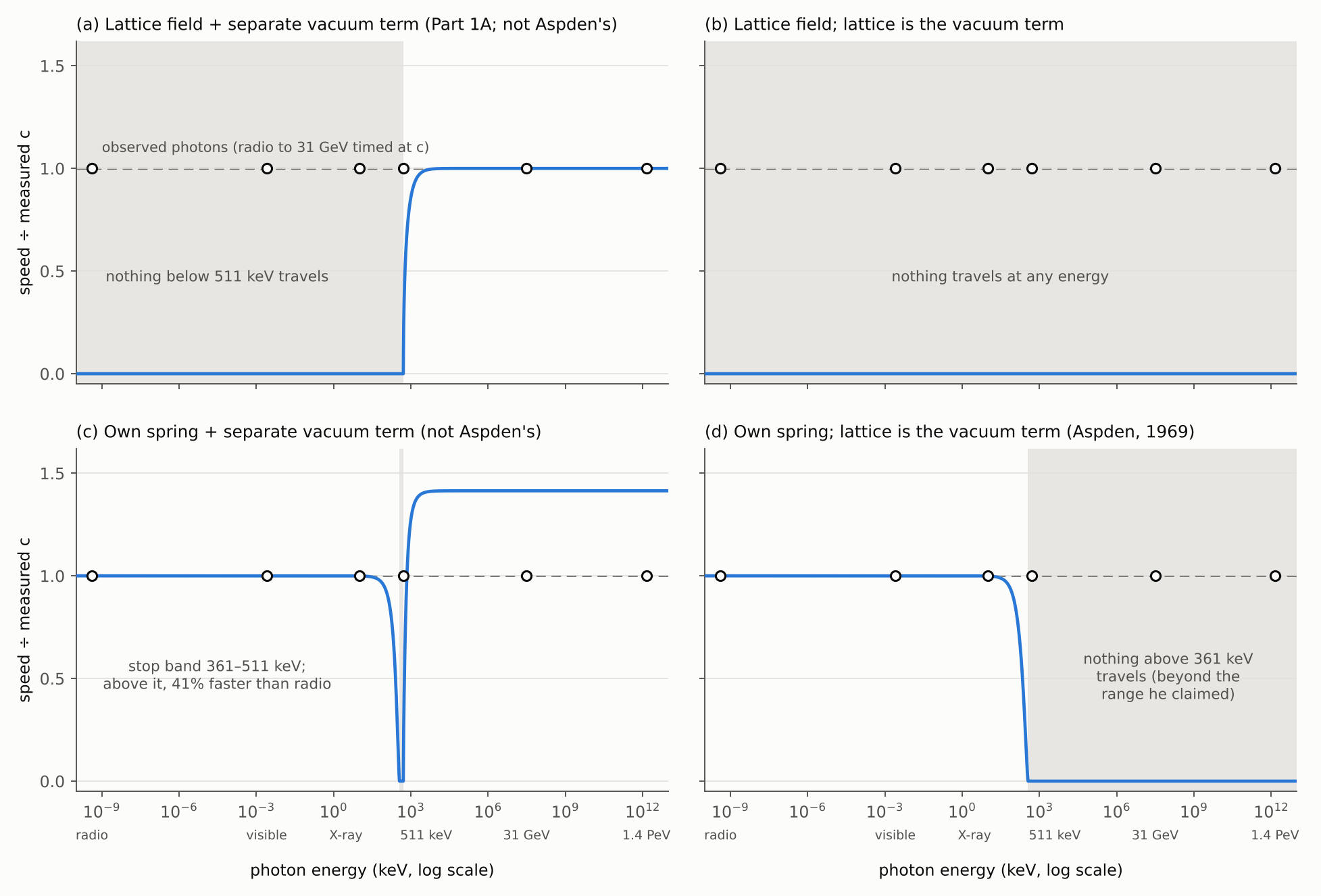
Figure 1. The blue curve is the speed of light in each model (its group speed: the speed at which a pulse and its energy travel), divided by the measured speed of light (in panel (a), where radio waves cannot travel, by the speed far above the cutoff), on a logarithmic energy scale from radio waves to the highest-energy photons seen. The open circles mark photons observed to travel; those from radio waves to 31 GeV have been timed at c. Grey bands mark energies at which the model lets nothing through.
- The rows differ in what pulls a displaced quon back: the field of the displaced lattice, or a spring of its own.
- The columns differ in whether a separate vacuum term is added (left) or the lattice is the vacuum term, as Aspden says (right).
- Panels (a) and (c) are not Aspden’s. Both add a separate vacuum term; in (c) it is what makes high energies run 41% faster.
- Panel (d) is his 1969 formula.
What each model shows.
-
(d) tests a published equation.
- Within the range he claimed for it (p ≪ p₀, his condition for "unity"), red and blue light travel at speeds differing by 7.4 × 10⁻¹¹. That is 1.5 million times the limit he later quoted (L3), and the failure is the formula’s own.
- Within that range it also fails a second way: vacuum Cherenkov radiation. The formula makes the vacuum’s refractive index slightly above 1 (n − 1 = 2.4 × 10⁻¹¹ for visible light). Electrons within 1.2 × 10⁻¹¹ of c would then outrun light in vacuum and radiate. LEP’s 104.5 GeV electrons are that fast. Counting their emission only up to 3.6 keV, 1% of p₀, they would lose about 12 MeV per metre: some 300 GeV per turn of the 26.7 km ring, three times their energy (L15). LEP ran at that energy, and its beams circulated with only the expected synchrotron loss. The method is that of Hohensee et al. (2009).
- Taken beyond that range, it lets nothing between 361 keV and 1.4 PeV through. But on the same page Aspden wrote that "propagation at such high frequencies involves another mechanism … through the medium separating the lattice particles" (section 3). So the gamma-ray failure tests the formula beyond his stated range, not his account as a whole.
- The formula would pass the burst test only if p₀ exceeded about 3 × 10¹⁹ eV. That needs a restoring force about 9 × 10²⁷ times his. The same force holds his orbit (PWE eqs. 6.1 and 6.34), so the orbit would no longer run at the Compton frequency, and the numbers of Part 1 that follow from it would be lost (L3).
Aspden recognized the dispersion problem by 1982 and proposed the dual displacement, so this formula may not be his final word.
-
(a) and (c) both add a separate vacuum term, which Aspden’s theory does not have, so neither tests his theory. Their failures, the 41% included, show only that adding a separate vacuum term cannot be the way out.
-
(b) and (d) are the models in which the lattice is the vacuum term. (b) shows that a lattice held only by its own field cannot be the whole vacuum. (d) is his own formula.
All four models share S1–S4 and S8–S12. (c) and (d) relax S5 through R2, and (b) and (d) through E2. So Aspden’s own model (d) already goes beyond Coulomb’s and Maxwell’s laws, and still fails within its range. A model that carries light must change at least one of the shared assumptions (section 8).
6. Variations, each relaxing one assumption
6.1 Relativity at c/2 (S11)
Charges moving at c/2 have a Lorentz factor of 1.155. If the orbit stays at the Compton frequency, as the theory requires, m₀ must already be the moving mass. The relativistic effects then come out as follows (L5):
- Light polarized along the orbit axis, and light in the orbit plane circularly polarized the same way as the orbit, keep their edge at 511 keV whatever the speed. The second of these modes is the orbit itself.
- Light circularly polarized against the orbit has its edge lowered, to 478.5 keV at c/2. Even as the speed approaches c, the edge stays above 361 keV, tending to (√3 − 1) × 511 = 374 keV.
- The orbit plane becomes gyrotropic: it treats the two senses of circular polarization differently. There is a weak sideband near 1.5 MeV.
These results come from an exact solution in the frame turning with the orbit (L5). An earlier estimate averaged over the orbit (478 keV, tending to 361 keV) is kept in L5 for comparison.
Holding m₀ at its rest value instead gives 445–476 keV at c/2, but then the orbit itself slows to 476 keV, contrary to S1.
In laser-plasma physics a very intense laser can push electrons so close to c that a plasma which would otherwise block the light lets it through (relativistic induced transparency; Kaw and Dawson 1970). That needs the laser to drive the electrons. Here the motion is the plasma’s own oscillation, and with the orbit fixed at the Compton frequency the effect cannot open the vacuum to light below 361 keV. Aspden himself says the synchronism prevents any relativistic increase of mass.
6.2 The orbit seen by a light wave (S9)
The orbit’s radius, 1.93 × 10⁻¹³ m, is about 4 × 10⁻⁷ of a visible wavelength (L1).
-
Doppler shift. The phase of a visible light wave at a quon wobbles by only kr = ω/2Ω = 2.4 × 10⁻⁶ as the quon circles (L6). The Doppler shift at any instant is ±ω/2, but it reverses 10²⁰ times a second.
-
The wave’s magnetic field pushes a quon (charge +q, velocity v) and its continuum partner (charge −q, velocity −v) with the same force q v × B. So the field moves the two frames together and does not separate them. What remains is again of order kr.
-
Near 511 keV the picture changes. There kr = 0.5 (L4): the orbit is no longer small against the wavelength.
So treating light as a small disturbance riding on the orbit (S9) is accurate to a few millionths for visible light, but not near the band edges. That says nothing about models in which the counter-motion itself carries light. Those are a different kind of model, and none has been built (section 8).
6.3 The dual displacement: the muon sea (S4 kept)
What it would have to do. Aspden writes the wave’s field as E = E₁ − E₂, with E/E₁ = (f/f₀)² (1984e; Tutorial Note 18). E₁/E = (f₀/f)² is exactly how strongly free quons respond to a wave (L7). So the muons’ counter-field E₂ must cancel all but 1 part in 4.2 × 10¹⁰ of it for visible light, and 1 part in 1.5 × 10²⁴ for radio. To meet the photon-mass limit, what is left uncancelled must be below 3.8 × 10⁻⁴⁸ of the lattice’s response.
That target assumes a separate vacuum term (E1). With the lattice as the vacuum term (E2), as Aspden holds, the target is harder still: the quons and muons together must supply exactly ε₀ at every frequency, and no linear system of charges with mass can do that (section 4.2).
Within linear response (S4 and S5), moving charges cannot do this.
- Charges pushed by the wave add to the response. A wave pushes positive charges one way and negative charges the other, so either way the current flows in the same direction. Every species adds n q²/m to the medium’s response, whatever its sign.
- For the same reason electron–positron pairs do respond to a wave, contrary to Aspden’s 1984 remark. A pair plasma blocks low frequencies as an electron plasma does, with twice the strength.
- The ionosphere is a working example of "dynamic balance". Electrons and oxygen ions, neutral overall, move in opposite directions as a radio wave passes, and their momentum balances. The ionosphere still reflects radio waves below about 9 MHz. The ions raise that cutoff by 0.002%; they do not remove it (L7c).
- A partner tied to the quons by momentum balance cannot cancel their dipole. If the muons are tied to the quons by momentum balance rather than pushed by the field, their dipole is m₀/m_μ = 0.02% of the quons’, however many muons there are. Their motion also adds inertia.
- With one muon per quon this leaves 99.94% of the quons’ response (same charge) or 100.02% (opposite charge).
- A lighter muon sea lowers the response by adding inertia, not by cancelling it: to half with equal mass densities.
- Reaching the photon-mass limit this way would need a muon sea less than 4 × 10⁻⁴⁸ as dense in mass as the quons: a lattice made immobile, not a response cancelled (L7b).
- Complete cancellation needs a partner with the quon’s own charge-to-mass ratio. Then the pair carries no net displacement current, which contradicts S2.
A self-tuning medium is outside these assumptions. Aspden’s later version retunes itself to the frequency of each passing signal (1983; 1991). That medium is not linear, so it is not covered by S4. Two difficulties would face any model of it:
- Mixing. A response set by each signal’s frequency would make light of different colours travelling together interact. Aspden held that the medium can follow one composite signal moving one way, but no mixing of colours is seen in vacuum, and the colours of the Crab pulsar’s light arrive together.
- Opposite directions. Signals going opposite ways are everywhere: starlight and the microwave background arrive from all directions, and every optical cavity holds two waves going opposite ways. Aspden named this himself as "a dilemma".
He gave no equations for either, so the idea cannot yet be tested. It is the most important open item for the dual displacement.
6.4 A phase-lock modelled as a gyroscope (S5 relaxed, in a form we chose)
Aspden’s phase-lock keeps every orbit in step with the surrounding aether. He describes three effects of it:
- a moving lattice has its orbits shifted sideways (1987);
- a steady field makes the quons drift at right angles to it (2003);
- a radial field sets the aether spinning.
Sideways response to a push is how a gyroscope behaves, and how charges behave in a magnetic field. "Gyroscope" is our word, not his, and so is the form of the force we tried: each frame responding as if gyrating at the orbit frequency. What follows illustrates what a phase-lock force would have to do. It is not a test of Aspden.
-
The two frames turn the same way, so a gyroscope-like (Coriolis-like) force acts on both in the same sense. Then only one polarization survives. Travelling along the orbit axis it is circularly polarized and moves at 0.0044c for visible light; at other angles it is slower. The other polarization is blocked in every direction (L8).
-
If the force acted in opposite senses on the two frames, as a magnetic field acts on opposite charges, light polarized in the orbit plane would see a bound medium. The result depends on the vacuum term (gyration rate ω_g = Ω):
- with a separate vacuum term (E1, not Aspden’s): ε = 1 + Ω²/(ω_g² − ω²). There is a stop band from 511 to 723 keV, and above it light runs 41% faster than radio waves. The orbit itself would also move to 723 keV.
- with the lattice as the vacuum term (E2): ε = Ω²/(ω_g² − ω²). This is exactly 1 at low energy, which is Aspden’s 1982 picture of a vacuum resonating at the Compton frequency, and nothing above 511 keV travels (L8).
-
Light polarized along the orbit axis feels no gyroscopic force. With E1 it meets the plasma and is blocked below 511 keV; with E2 it travels at no energy.
Aspden’s words on which motions are free point both ways. The "two degrees of freedom" passage (POC 2003 ch. 5 and 8) concerns the quons’ thermal energy. "Lateral" is ambiguous in his usage, and he adds that the assumption "may be too rigid an assertion". Physics Unified (ch. 5) supports reading the excluded freedom as the "frequency distortion" along the orbit. But his 1997 note says a wave with its field "orthogonal to the orbits" passes "unaffected" at domain boundaries, which points the other way.
-
To move the resonance above the highest photons observed, the gyration rate would have to be 2.7 × 10⁹ times the orbit frequency. The orbit would move with it, and light polarized along the axis would still be blocked.
6.5 Above the Compton frequency
By Aspden’s own account the counter-displacement ends at "the frequency at which electron-position [sic] pair creation occurs", with E₂ = 0 at the Compton frequency (1982; 1984e; Tutorial Note 18). Above it, the lattice’s own response governs.
- With the lattice as the vacuum term (E2), as Aspden holds, the lattice’s permittivity above Ω is negative in both R1 and R2, so no gamma ray above 511 keV travels.
- With a separate vacuum term (E1, not his), gamma rays travel, but late. The 31 GeV photon of GRB 090510 would arrive about 283 days after the burst’s keV light in model (a), and about 142 days after in model (c). Fermi saw it within 0.86 s, 2.8 × 10⁷ and 1.4 × 10⁷ times sooner (L9).
- In model (d), with low energies carried at c, nothing above 511 keV travels.
So two of Aspden’s explicit statements, that the lattice is the vacuum’s permittivity and that the counter-displacement stops at the Compton frequency, together imply that gamma rays above 511 keV need a carrier other than a linear lattice of charges with mass (section 4.2). His texts offer only the 1969 "another mechanism" through "the medium separating the lattice particles", without equations.
A photon needs 1.022 MeV, not 511 keV, to make a pair. Aspden equates the pair-creation frequency with the Compton frequency. The GRB delay is set by Ω, so it is the same either way.
7. Observations any model must meet near 511 keV
Aspden tuned his vacuum’s rhythm to the electron’s rest energy. Every model above has its largest effect between 361 and 723 keV. That is where the photons made when electrons and positrons annihilate sit, among the most studied photons in physics and medicine. These observations are model-independent targets for any future model.
Near 511 keV the smooth-medium treatment is only approximate (kd ≈ 1.2–2.3; S10). The entries below show where each model fails, not exactly by how much. The colour test and the burst test are not affected.
| Observation | (a), not Aspden’s | (b) | (c), not Aspden’s | (d) Aspden 1969, beyond the range he claimed |
|---|---|---|---|---|
| 511 keV annihilation photons timed at 0.995 ± 0.005 of c (1951) | Fails: at most 0.07c inside the line’s width | Fails | Fails: blocked or below 0.07c | Fails: blocked |
| PET scanners pair the two 511 keV photons within nanoseconds | Fails | Fails | Fails | Fails |
| The Galaxy’s 511 keV line is seen whole, peaking at 511.09 ± 0.08 keV, 2.6 keV wide (Siegert et al. 2016) | Fails: lower half removed | Fails | Fails: lower half removed | Fails: all removed |
| The positronium continuum below 511 keV is seen from the Galaxy | Fails: blocked | Fails | Fails: 361–511 keV blocked | Fails above 361 keV |
| Cs-137 (662 keV) gamma rays cross every laboratory | Passes, at 0.635c | Fails | Passes, at 0.91c | Fails |
| GRB 090510: keV and 31 GeV photons arrive together | Fails: keV light blocked | Fails | Fails by 1.3 × 10¹⁷ | Fails: GeV light blocked |
These ratios use 0.859 s ÷ light-travel time; weighting the distance for each model’s own law changes them by a factor of a few at most, against margins of 10¹⁶ or more.
On the 511 keV line. Removing either half of the line would make it lopsided and move its mean energy by about 0.9 keV, 11 times the measurement’s error (L13).
The continuum held still (S12). If the continuum is held still during a wave, as Aspden did in 1969, model (a)’s edge falls to 361 keV. The Galactic line then passes whole and Cs-137 travels at 0.84c. But 511 keV photons travel at 0.71c, 58 standard deviations below the 1951 measurement (L9b).
Part 1 (test U13) set this line aside for the 1982 resonance picture, on the grounds that light just below a resonance is slowed rather than stopped. That missed the half of the line that falls inside the stop band. Part 1 used Ω (511 keV) for the spring where Aspden’s 1969 formula has p₀ (361 keV). Both points are corrected in Part 1 (version 1.6) and the test register (version 1.5).
8. Extending the theory: models worth building
Aspden worked on his theory for five decades, largely alone, without the refinement a research community gives a mainstream theory (working paper, finding 3). This section therefore does more than test. It proposes extensions that might make the theory work, marked [P] to keep them apart from what Aspden said. Each is a model to be built and tested, not a result.
To count as an improvement, an extension must:
- be written as equations, with no parameter fitted to the data of sections 2 and 7;
- not take ε₀, μ₀ or c as inputs where it claims to derive them;
- meet the observations of sections 2 and 7, and any further tests its own mechanism makes relevant;
- keep the fine-structure chain of Part 1 and the orbit at the Compton frequency, or state exactly what it gives up;
- register at least one prediction that has not yet been measured.
8.1 Where a working model must depart from sections 5–6
The dilemma of section 4.2 rests on S2–S5, S7 and S8, and adding a separate vacuum term (E1) fails as well. So a model of Aspden’s aether that carries light must change at least one of S2–S5 or S8. Each route below has a basis in his texts or in the project lead’s proposal.
- Drop S4 (linear response). This is his self-tuning dual displacement, his remedy for dispersion. It needs equations of motion for the muon sea, and it would have to reproduce section 2: colours travelling together without mixing, and waves crossing in opposite directions.
- Drop S5 (only Coulomb’s and Maxwell’s forces). This is his phase-lock, written as a force law derived from the synchronism condition (§8.3). He used the phase-lock for translation, rotation and the capacitor effect, not for light.
- Drop S8 (μ₀ and Faraday’s law given), and with it S9. This is the project lead’s proposal. The aether supplies ε₀ and μ₀ itself (§8.2), and light is a wave of the medium, carried by the relative motion of the frames that Aspden identified with c, rather than a small disturbance riding on its orbit (§8.4). If, as Aspden says, there is no magnetic field in free space, such a model needs some coupling other than Faraday’s law to pass the wave from place to place. The nearest existing calculation is the Coulomb shear wave of §8.4, which does not work as it stands.
- Give up S2 above the Compton frequency. This is his "another mechanism" for high frequencies, through "the medium separating the lattice particles" (PWE 1969). No equations are given (§8.5).
Two routes are closed under the shared assumptions:
- making the lattice so stiff that its natural frequency lies above 1.4 PeV. The same force sets the orbit, which would leave the Compton frequency (section 5);
- making the lattice so weakly coupled to light that light does not see it. The coupling would have to be below 5 × 10⁻¹⁸ of Coulomb’s strength for a spring-like response, or 3.8 × 10⁻⁴⁸ for a plasma-like one (L10). The lattice would then carry none of the displacement current, contrary to S2.
8.2 [P1] The aether as the source of ε₀ and μ₀
If the aether is real, ε₀ and μ₀ are not independent constants of nature. They are properties of the aether, so it should be possible to work back from them to the aether’s properties. In matter, ε_r and μ_r would then describe how matter changes the aether’s response; that second step comes after the first.
- ε₀. His eq. 6.34 makes the unity term exactly 1 for any n, q and m₀, and Part 1A computed m₀ from the same restoring force. So the relation is an identity, not a test (L14). In SI, with e, h and c fixed, ε₀ = e²/2αhc, so deriving the number ε₀ is the same as deriving α, which Part 1’s chain already does. What P1 must add is physics: a restoring force that does not presuppose a bare vacuum term and gives the lattice exactly the unity term at every frequency.
- μ₀. Aspden says a wave’s "magnetic" energy is the kinetic energy of the quons (Research Note 4/98). Suppose the two frames carry the wave’s displacement current, equally and oppositely.
- How big it is. Their kinetic energy, averaged over a cycle, is (ω/Ω)² times Maxwell’s magnetic energy: 2.4 × 10⁻¹¹ for visible light and 6.5 × 10⁻²⁵ for radio (L14).
- Where they are equal, and why. They are equal only at ω = Ω. That is not a separate coincidence: it is the condition for the medium’s free oscillation, and Ω is the two frames’ plasma frequency by construction (Part 1A §5). With the continuum held still, as in Aspden’s 1969 analysis, equality moves to p₀ = 361 keV. Aspden made the same point: when the medium’s natural frequency equals the signal’s, energy can pass "between the electric field and the kinetic energy of the displacement rate" with no "true magnetic field" (Lecture 10 Appendix).
- The timing is wrong. This kinetic energy peaks when E is zero, whereas Maxwell’s magnetic energy in a travelling wave peaks with E. This is Aspden’s standing-wave exchange, in which energy does not travel with the wave (section 9).
- More inertia is not the answer. To match at every frequency, the frames’ effective inertia would have to grow as 1/ω². That is a stiffness, not an inertia.
- A better candidate [P]. In the gyroscopic model of §6.4, with the two frames turning opposite ways and the gyration rate equal to Ω, both frames drift at right angles to E, as Aspden describes for a steady field (POC 2003 ch. 9).
- It matches in size and timing. The kinetic energy of that drift equals Maxwell’s magnetic energy ε₀E²/2 exactly, at every frequency well below Ω, and it rises and falls with E² as magnetic energy does (L14).
- It is consistent with §6.4. It comes from the same parameter that gives ε = 1 in §6.4 with the lattice as the vacuum term.
- What remains. Of the forms tried here, this comes closest to Aspden’s statement about magnetic energy. But it still needs Faraday’s law to make the wave travel, and light polarized along the orbit axis is still blocked.
- The test any such model must pass. Here r is defined as c/2Ω, so c = Ω·2r holds by definition (L14). The non-circular test is dimensionless: the model’s own wave speed divided by 2Ωr must come out as 1. For the Coulomb shear wave of §8.4 it is 0.215–0.279.
8.3 [P2] Phase-locked orbits and their angular momentum
The orbits carry a great deal of angular momentum. Each quon has m₀(c/2)r = 0.0102ħ, exactly (m₀/4mₑ)ħ, and the two frames together hold 8.3 J·s per cubic metre (L14). It cannot be ignored.
In a linear model, the orbit and the response to a uniform push simply add, so the angular momentum cannot affect the response. (With relativistic mass at c/2 it does, and the orbit plane becomes gyrotropic, §6.1.) The quon–continuum pair also has no magnetic moment, so a magnetic field cannot turn it.
Aspden’s synchronism changes that picture. Every orbit keeps its frequency and phase in step with the surrounding aether, a constraint "precluding the third degree of freedom" (POC 2003 ch. 8).
- What he uses it for:
- to count a quon’s thermal energy as kT rather than 3kT/2 (POC ch. 5 and 8; Physics Unified ch. 9);
- to hold the quon’s mass constant, so that the system "behaves as a linear oscillator" (Physics Unified ch. 5), the basis of S11.
- What he does not do is derive it from the forces. Under Coulomb’s law alone a quon is free to move in all three directions (S5).
The rule in cylindrical coordinates. Take the most direct reading of Physics Unified ch. 5 and POC ch. 5 (but see §6.4). In coordinates (r, φ, z) about each orbit’s centre, with z along its axis, δr and δz are allowed, and δφ, the slip from φ = Ωt, is locked. Then:
- What is locked is the rhythm, not the angular momentum. The angular momentum m₀r²φ̇ still changes when r changes, so the surrounding aether must supply or absorb the difference. Aspden’s "vacuum spin" (Lecture 26; Feedback Note 8) is his account of that exchange.
- The orbit’s centre can still move. A uniform field shifts all the centres together, and that collective shift is the displacement current (POC eq. 6.1). Aspden adds that under the phase-lock a steady field also drives the charges at right angles to it (POC 2003 ch. 9), though he doubted this for parallel plates in 2002 (Lecture 27 notes). That sideways drift is the gyroscope-like response of §8.2.
- Taken literally, the rule makes things worse for light in the orbit plane. Take one quon on its own spring (R2), circling a centre that stays fixed (the scenario Aspden describes in POC 2003 ch. 9), with its angle about that centre locked to Ωt. A weak, slow field E lies in the orbit plane.
- The radial motion becomes free. In polar coordinates the radial equation is m(r̈ − rΩ²) = −mΩ²r + qE cos Ωt. The centrifugal term cancels the spring exactly. This is his own observation that every orbit radius has the same frequency, now acting on the quon. What is left is m r̈ = qE cos Ωt: a free particle driven at the orbit frequency.
- The quon moves against the field. A free particle driven at frequency Ω moves opposite to the push, δr = −(qE/mΩ²) cos Ωt.
- On the side of the orbit where the field pushes outward, the quon moves inward.
- On the opposite side, where the field pushes inward, it moves outward.
- So on both sides it ends up displaced against the field.
- Averaged over an orbit, the shift along E is −qE/2mΩ², because a quarter-turn from those two points the push is across the radius and contributes nothing.
- A free quon would instead have its whole orbit shifted with the field by +qE/mΩ². The locked response is therefore −½ of the normal one, at every frequency well below Ω (L14).
- Holding the phase takes a large rhythmic force. The lock must supply a force along the orbit of 3qE sin Ωt: twice qE to cancel the Coriolis force 2mΩṙ, and once qE to cancel the field’s own push along the orbit. That force exchanges energy with the quon at the orbit frequency, averaging to zero over each turn.
- Aspden foresaw this. He described exactly this situation: charges "displaced in unison relative to the centres about which they are in circular orbit" could not keep in synchronism "unless they were subject to a continuous very high frequency oscillation of energy exchange, something I felt was impossible". He therefore proposed the right-angle drift instead (POC 2003 ch. 9). In 2002 he reconsidered: "what I at first deemed to be impossible may indeed be possible" (Lecture 27 notes).
- The consequences.
- With the lattice as the vacuum term (E2), the in-plane response of −½ gives ε = −½. Light polarized in the orbit plane cannot travel, and that includes all light travelling along the axis. Light polarized along the axis, where the quon moves freely, is not affected, so the vacuum would act as a polarizer.
- With the lattice’s own field as the restoring force (R1), no spring balances the centrifugal term, and the radial motion is unstable.
- The same algebra applies to the relative motion of the two frames.
- What the result assumes. The lock is applied about a fixed centre. If instead it is applied about the orbit’s instantaneous centre, a uniform push simply moves the whole orbit, the response is the normal one, and the lock affects only uneven deformations of the lattice.
- What it leaves for P2. So P2 must derive which motions the phase-lock leaves free, not assume them. The 3qE sin Ωt lock force, the right-angle drift of §8.2, and Aspden’s equations for the sideways orbit shift (1987b) and for vacuum spin (Lecture 26) are concrete starting points. The script
lock_check.pychecks the −½ and the 3qE numerically.
A geometric comparison, and why it is not yet a match. In a light wave a free charge moves in two ways:
- along the wave’s electric field, across the direction of travel (first order in the field);
- along the direction of travel, the direction of the Poynting vector, under the wave’s magnetic force (second order; this is radiation pressure).
Neither needs a field component along the direction of travel, which free waves do not have. If an orbit’s axis lies along the direction of travel, the rule allows radial and axial motion, which resemble these two. The comparison fails in three ways:
- Half the push is locked. The push in the plane is half locked, as shown above.
- His texts can be read the other way. Under the other reading (§6.4), the plane is free and the axis locked, so the push is allowed and radiation pressure is forbidden.
- Light comes from every direction. Within a domain all orbits share one axis, but light arrives from every direction. Two beams crossing, as in any interferometer, would need the orbits to point along both at once. That is the general form of the "dilemma" Aspden named for waves in opposite directions. A uniform field puts no average torque on a circular orbit, and the pair has no magnetic moment, so in the linear model nothing turns the orbits. His remark that the lattice "cannot withstand turning forces" (PWE 1969) concerns the lattice rotating, the basis of his photon account, not orbit axes turning to follow a wave.
8.4 [P3] Light as a sound-like wave of the lattice
Sound gives the pattern a working model of light must follow. A sound wave in air or water travels at √(stiffness/density), at a speed that does not depend on frequency while the wavelength is much longer than the spacing of the molecules.
Aspden proposed the same for light:
-
c₁ = √(P/ρ), with ρ the lattice’s mass density (Physics Unified 1980 eq. 59; POC 2003 eq. 9.18);
-
the rigidity "could stem from the powerful electric interaction forces between the q charges" (Physics Unified ch. 3);
-
"Maxwell’s equations demand a solid-like structure to sustain the lateral oscillations associated with wave propagation" (Lecture 3 Appendix, 1997).
-
Transverse, not longitudinal.
- A freely travelling wave in empty space has no charge to act on, so Maxwell’s equations require ∇·E = 0, and the wave has only the two transverse polarizations.
- Field components along the direction of travel occur in tightly focused beams, near antennas and inside waveguides (the TM modes), with ∇·E = 0 still holding. Longitudinal waves need a charge density that oscillates, as in a plasma (Langmuir waves).
- In Aspden’s charged lattice the Coulomb field lifts any longitudinal wave to the plasma frequency, 361–511 keV (Part 1A §4.4, §10). Below that there is no longitudinal wave to excite, so his lattice partly avoids the old difficulty of the elastic-solid aether. Above it a model must explain why the wave is not excited.
- Light reaching us across space shows only the two transverse polarizations, so the wave that carries it must be a shear wave of the lattice: the kind a solid carries.
-
Aspden’s suggestion, tested. Part 1 (U38) computed the shear waves that Coulomb forces between quons give his lattice, using exact lattice sums:
- 0.215c along the cube diagonal, and 0.279c along a face diagonal, where one mode is also unstable;
- both modes unstable along the cube edges;
- 18.4% of all the lattice’s modes unstable (Part 1A §10).
Part 1 records it as excluded as the carrier of light. An order-of-magnitude estimate from his lattice’s mass density (143 g/cm³) and its Coulomb stiffness gives 0.33c (L14). Written out, that estimate equals (d/r)/(2√(8π)), and d/r = 144πα. So the ratio is fixed by his fine-structure chain, and it cannot be raised without breaking the chain.
-
Two further results limit what these speeds mean.
- By Coulomb’s law a transverse polarization has no macroscopic field, so this wave cannot by itself give light’s transverse electric field.
- With Faraday’s law kept (S8), the wave’s current couples to the field it induces at every wavelength above the quons’ skin depth, 5.5 × 10⁻¹³ m. Visible light would then travel at about 0.0024–0.0028c, rising as √ω, and radio waves at about 10⁻⁶c. Even a lattice whose shear speed was c would give only 0.005c for visible light (L14).
So P3 needs a new coupling, other than Coulomb’s law and Faraday’s law, that gives light its transverse field without loading the wave with the quons’ inertia.
-
Precedents.
- MacCullagh (1839) proposed a medium whose energy depends only on local rotation. It carries only transverse waves, and FitzGerald (1880) showed its equations are Maxwell’s for empty space.
- Kelvin’s gyrostatic aether (1889–90) got that rotational stiffness from spinning gyrostats, a precedent for combining P2 with P3.
- Aspden’s texts describe his lattice both ways: it "can withstand linear force" but not "turning forces" (PWE 1969), yet it "cannot withstand linear forces because it will yield as a fluid" (Lecture 3 Appendix, 1997).
The project lead’s picture: spin-like orbits on lattice sites [P]. A propagating medium needs a positive stiffness: a displaced part must be pushed back, and must push its neighbours. The −½ of §8.3 is a negative response, so a medium built that way cannot carry a wave. The project lead therefore proposes a different picture.
- The orbit is internal, like a particle’s spin about its own centre.
- The quon sits at its lattice site most of the time, as an ion does in a crystal.
- A bump is passed on. When a quon is bumped it pushes on its neighbours, and the bump travels along the lattice as a lattice wave, the way sound travels through a crystal.
In the terms of §8.3, this is the lock taken about the orbit’s moving centre: a push moves the whole orbit and the response is the normal one.
-
A precedent for treating the orbit as spin. In Dirac’s theory the electron’s trembling motion has amplitude ħ/2mₑc, which is Aspden’s orbit radius, and its angular momentum can be read as the electron’s spin (Huang 1952). Aspden’s quons carry 0.0102ħ each, so the analogy is in form, not in size.
-
A point in its favour. In a lattice of charges in a neutralizing background, a compression bump along the chain does not travel as low-frequency sound. Squeezing the lattice uncovers continuum charge, whose field acts across the whole region at once, so the compression oscillates at the plasma frequency (361–511 keV) instead of travelling. Only sideways (shear) bumps travel at low frequency. That matches light, which has only transverse polarizations.
-
What it must overcome. These are the obstacles already found for shear waves (above and §8.5):
- Speed. Coulomb forces give 0.215–0.279c, a ratio fixed by the fine-structure chain.
- Stability. The simple cubic arrangement is unstable. For like charges in a neutralizing background the stable arrangement is body-centred cubic: the Wigner crystal.
- Direction. The speed would depend on direction by about 30%, against the 10⁻¹⁸ isotropy limit.
- Colour. Different colours would travel at different speeds, through discreteness (§8.5).
- No electric field. By Coulomb’s law the wave has no macroscopic electric field; with Faraday’s law kept, it is slowed to about 0.003c.
- Gamma rays. Above about 0.6 MeV a lattice cannot pass a wave from site to site at all.
Each obstacle is a specific requirement on the extra force a working model must add. It must be 13–22 times stiffer, stable, the same in every direction, free of dispersion at long wavelengths, and it must give light its transverse field. This is the model the lattice simulation (section 10, item 4) should build first.
8.5 The spacing and the wavelength
A wave’s wavelength equals the lattice spacing (6.37 × 10⁻¹³ m) at a photon energy of 1.95 MeV. The highest frequency a lattice can pass from site to site, ħ·2c/d, is 0.62 MeV; a free-space wave of wavelength 2d has 0.97 MeV (L14).
At 511 keV the wavelength is the electron’s Compton wavelength, 2.43 × 10⁻¹² m, only 3.8 lattice spacings.
- It is not a coincidence of the numbers. The ratio equals 4πr/d, so it is fixed by the same r/d = (3/4)(8/1843)^(1/6) that gives Aspden’s fine-structure constant.
- The orbit matches too. The wavelength divided by 2π equals the orbit’s diameter, 2r, exactly.
- So the smooth treatment is weakest exactly where it matters. The energies where every model in sections 5–6 has its strongest effect are also the energies where the wave is only a few spacings long. There the smooth-medium treatment (S10) is least reliable, and a calculation on the discrete lattice (section 10, item 4) is most needed.
If light hops from site to site (nearest-neighbour coupling), discreteness slows its group speed by (kd)²/8 (L14):
- Visible light (780,000 spacings long): 8.2 × 10⁻¹². Red and blue light would differ by 8.4 × 10⁻¹², 170,000 times the limit Aspden quoted. The speed would also depend on direction, by about 2 × 10⁻¹², against an isotropy limit of 10⁻¹⁸.
- X-rays of 1 keV: 1.3 × 10⁻⁶.
- 100 keV: 1.3%.
- Gamma rays above about 0.6 MeV could not be carried from site to site at all.
Only for radio waves and microwaves is the discreteness effect below the limits of section 2. For visible light the (kd)² terms would have to cancel to better than 1 part in 10⁵.
For gamma rays, which are seen from 0.6 MeV to 1.4 PeV travelling at c, something else is needed. Aspden assigned high frequencies to "another mechanism", propagation through "the medium separating the lattice particles" (PWE 1969). A model built on that idea would have to carry all frequencies at one speed, with no seam between the two mechanisms.
Structure within structure. If the "other mechanism" were itself a finer lattice, it would reveal itself the same way, at wavelengths near its own spacing. The question then becomes how many such levels there are. This is how structure is found in matter. Sound sees a crystal as smooth until its wavelength nears the atomic spacing. X-rays then show the atoms by diffraction, and gamma rays and fast particles show the nuclei. The observations set a limit on any next level:
- The limit. A lattice that carried GeV light from site to site would slow it by about (kd)²/8. The 31 GeV photon of GRB 090510 therefore requires a spacing below about 2 × 10⁻²⁶ m, some 3 × 10¹³ times finer than the quon lattice (L14). That is still about nine orders of magnitude above the Planck length, 1.6 × 10⁻³⁵ m.
- Aspden’s own answer may be two levels. His theory already contains a medium with no spacing at all: the uniform charge continuum, and the energy medium around the lattice particles. A true continuum has no cutoff. The question for a model is then how a continuum could carry transverse waves at c with no dispersion while staying the reference medium of the quon lattice.
- In standard physics the bottom level is the field itself. It is smooth and looks the same to every moving observer, which is why no dispersion has been found at any scale yet tested.
8.6 [P4] Matter: ε_r and μ_r
In Aspden’s picture the aether is present inside matter, and matter’s response adds to it: (c/v)² = 1 + φ. A model of how matter changes the aether’s response would have to reproduce the refractive indices of real materials, and their approach to 1 at X-ray and gamma-ray energies.
It would also have to reproduce Cherenkov radiation (Cherenkov 1934; Frank and Tamm 1937). A charged particle moving through matter faster than light’s speed there, c/n, emits light on a cone at the angle cos θ = 1/(nβ). Gamma rays do not emit it themselves; the fast charged particles they set moving do. Those are Compton electrons (with beta particles, the blue glow of reactor pools) and, at high energy, the electron–positron pairs of air showers that gamma-ray telescopes see.
In matter, Cherenkov radiation follows from n(ω) once Maxwell’s equations for a medium hold, so it tests mainly that a model reproduces n(ω). Applied to the vacuum itself, the same physics gives a sharp test of any aether whose index exceeds 1. That test is applied to Aspden’s 1969 formula in section 5.
Whether matter alters the quons’ locked rhythm, as the project lead has suggested, is speculative at this stage. This is the second step, after P1–P3.
8.7 A vacuum that responds and still leaves light alone
The physics we know shows this can be done. In quantum electrodynamics the vacuum is polarized by virtual electron–positron pairs at the distance ħ/2mₑc, the radius of Aspden’s orbit. Yet freely travelling light is unaffected, because that polarization looks the same to every moving observer (it is Lorentz invariant). It shows up only near charges or in strong fields: in the slow change of the fine-structure constant with energy, and as the −27 MHz vacuum-polarization part of hydrogen’s Lamb shift (Part 1, section 10).
Any working extension of Aspden’s aether would have to share that property. A lattice has a rest frame and a spacing, so it can at best mimic Lorentz invariance to the precision of section 2. Section 8.5 shows that discreteness alone breaks it at about 10⁻¹¹ for visible light.
9. Other ideas in his texts
- A separate energy medium (PWE 1969). Electric fields travel at c "in the medium which surrounds the lattice particles", a medium with a pressure and a density.
- In Aspden’s account that medium carries the inverse-square (Coulomb) field, whose action "is converted by lattice reaction" into the transverse Maxwell wave.
- He also assigns propagation at frequencies near Ω to it: "Propagation at such high frequencies involves another mechanism. This is the mechanism by which disturbances are propagated through the medium separating the lattice particles."
- No equations are given. A medium held together by pressure carries compression waves. How it would carry transverse light at high frequencies, and join the lattice’s waves at low frequencies without a seam, is open (§8.1, §8.5).
- The photon as an offset from the vacuum’s rhythm (PWE 1969 eq. 4.3). Radiation appears at four times the amount by which a photon unit’s rotation differs from Ω/4, with "no electromagnetic wave propagation" at Ω/4 itself. This is a rule for the frequency emitted, not a law for how the wave travels.
- Waves that carry no energy (Lecture 10 Appendix 1986/87; Tutorial Note 12, 1999). A symmetrized form of Maxwell’s equations gives waves at the same speed c that "will convey no energy from A to B". Yet energy demonstrably crosses empty space with light: sunlight delivers its energy about 8.3 minutes after leaving the Sun, and its pressure on matter has been measured since 1901 (Lebedev; Nichols and Hull).
- A critical field (1960). "a critical field strength which cannot be exceeded in a wave propagation", 2.21 × 10¹³ esu.
- He reduces it himself to V₀ = hc/16πer² (his eqs. 39 and 14). With r = ħ/2mₑc this is exactly mₑ²c³/2eħ = 6.6 × 10¹⁷ V/m: half the critical field of quantum electrodynamics, 1.32 × 10¹⁸ V/m (Sauter 1931; Heisenberg and Euler 1936; Schwinger 1951). The quon mass cancels, so his later numbers leave it unchanged (L11).
- The agreement follows from building both from mₑ, e, ħ and c. In quantum electrodynamics a single travelling wave of any strength creates no pairs, so it sets no maximum field for a travelling wave.
- The strongest laser field yet made, about 9 × 10¹⁴ V/m (1.1 × 10²³ W/cm², CoReLS 2021), is 730 times below his value. Reaching it would need about 6 × 10²⁸ W/cm²: half a million times today’s record, and beyond every laser now planned (L11).
- It is one of the few quantitative predictions about light in his texts, and it is untested.
- Frequency loss in transit (1984e; Lecture 11, 1998). Aspden proposed that light loses frequency as it crosses space, in place of an expanding universe. In a space that is not expanding, a distant supernova’s brightening and fading would arrive at the pace it happened.
- The Dark Energy Survey (2024) finds the light curves stretched by (1 + z)^b, with b = 1.003 ± 0.005 (stat) ± 0.010 (sys), as expansion predicts.
- The survey reports this as ruling out models without time dilation "at very high significance". Combining its two uncertainties, b = 0 is about 90 standard deviations away (L12).
- This tests his explicit claim, not a model of ours.
10. Open questions for later research
-
Build P1 and P3 (§8.2, §8.4).
- Derive ε₀ from the quons’ displacement under a restoring force that does not presuppose a vacuum term.
- Derive μ₀ from the motion of the frames. The best candidate found is their sideways drift under a gyroscopic phase-lock (§8.2).
- Treat light as a disturbance of the two counter-moving frames, rather than as a wave riding on a fixed orbit.
- Find the speed and its dependence on frequency, direction and polarization, and compare them with section 2. Check whether the model’s own wave speed divided by 2Ωr comes out as 1 without being put in.
This is the project lead’s question, and the most direct test of whether the c/2 counter-motion can carry light.
-
Build P2: write the phase-lock as a force law (§8.3).
- Derive it from the synchronism condition and find its wave equation.
- Aspden’s own equations for the sideways orbit shift (1987b eqs. 5–12) and for vacuum spin (Lecture 26 eqs. 1–3) are a starting point.
-
Give the dual displacement equations.
- Specify the muon sea’s density, charge, mass and coupling.
- If it is self-tuning, give the rule.
- Check the result against colours travelling together and against waves crossing in opposite directions.
-
Simulate the two-frame lattice. A particle simulation of a few thousand quons and a continuum would test items 1–3 without the smooth-medium and small-displacement assumptions (S4, S10). Start with the project lead’s picture (§8.4): orbits treated as spin-like internal motion, quons bumped from their sites, shear waves passed from quon to quon. Measure the speed, stability and direction dependence of those waves, and what extra force would bring them to c.
- Include the orbit at c/2 and, optionally, a phase-lock term.
- Probe it with a weak wave from 1 to 1,000 keV.
-
Test whether the orbit is stable. In plasma physics two charged media streaming through each other become unstable (the two-stream and filamentation instabilities), with growth rates near the plasma frequency. Whether the lattice spacing stabilizes Aspden’s frames is unknown. The simulation in item 4 would show it.
-
Build P4: model the aether inside matter (§8.6). In Aspden’s picture the aether is present in matter, and matter’s response adds to it (section 2.2). A model of how embedding changes the quons’ response would have to reproduce two things: the refractive indices of real materials, and their approach to 1 at X-ray and gamma-ray energies.
-
Watch the critical field. His 1960 limit, 6.6 × 10¹⁷ V/m, is beyond every laser now planned; it needs about 6 × 10²⁸ W/cm². Strong-field experiments that come closer are worth following.
-
Find the primary text. The full 1982 Wireless World article is wanted; its formula for the natural frequency is missing from the web copy.
11. What can and cannot be judged yet
Can be judged, because it tests his own equations or explicit statements:
- His 1969 formula for light in the vacuum, within the range he claimed for it. It makes colours travel at different speeds, 1.5 million times more than the measurement he later quoted allows, and it would make LEP’s electrons radiate away their energy in vacuum. Beyond that range it lets nothing above 361 keV through, but there he wrote that "another mechanism" takes over.
- The dual displacement, within linear response. Counter-moving charges pushed by a wave add to the lattice’s response. A partner tied by momentum balance cancels at most 0.02% of the quons’ dipole; any further reduction comes only from added inertia. His later self-tuning version is outside this result.
- Two of his statements taken together: that the lattice is the vacuum’s permittivity, and that the counter-displacement stops at the pair-creation frequency. Together they leave gamma rays above 511 keV with no linear lattice to carry them. His only alternative, "another mechanism", has no equations.
- His frequency-loss account of the redshift, against the time dilation of supernova light curves.
- His Earth-carried frame for light, against rotating cavities (Part 1A §13.4).
Cannot yet be judged:
-
Whether Aspden’s aether can carry light at all. Every model built so far shares assumptions S1–S4 and S8–S12, and within them none works. Three routes each drop at least one of those assumptions, besides his "another mechanism" for high frequencies:
- his self-tuning medium;
- his phase-lock, which he used for other effects, not for light;
- the project lead’s proposal that the frames’ relative motion, which Aspden identified with c, carries light.
None has been written as equations. Until one is, the question is open. Section 8 proposes four extensions (P1–P4) that would make it testable.
What holds:
- He saw the real difficulty clearly, and he quoted the right test of it.
- His orbit equation is exactly the plasma-oscillation equation of his medium, so the orbit he postulated is consistent with Coulomb’s and Newton’s laws.
- His 1960 critical field is exactly half the critical field of quantum electrodynamics (an agreement in scale, not in physics), and it has not yet been reached in any laboratory.
References
Aspden’s texts (all on aetherscience.org; Aspden on Light: Source Texts quotes each passage in full with its link):
- The Theory of Gravitation (1960), ch. 2 and 8, with 1998 notes.
- Physics without Einstein (1969), ch. 4–6.
- Physics Unified (1980), ch. 2, 3, 5 and 9.
- Wireless World 88, 37 (1982), reproduced as Lecture 24.
- Lett. Nuovo Cimento 38, 243 and 568 (1983).
- Lett. Nuovo Cimento 41, 252 (1984) ("1984e").
- Lecture 10 Appendix (1986/87).
- Hadronic J. 10, 185 (1987).
- Physics Essays 4, 13 (1991).
- Energy Science Report 8 (1996).
- Lecture 26 (1996).
- Research Note 11/97 and Research Note 4/98.
- Essay 13 and Lecture 11 (1998).
- Tutorial Notes 6, 8, 12, 18 and 20 (1997–99).
- Feedback Note 8 (2001).
- The Physics of Creation (2003), ch. 5, 6, 8 and 9.
Measurements and other works:
- A. A. Abdo et al., "A limit on the variation of the speed of light arising from quantum gravity effects", Nature 462, 331 (2009) (GRB 090510).
- B. Warner and R. E. Nather (1969), optical timing of the Crab pulsar at different wavelengths, as cited by Aspden (Lecture 10 Appendix).
- M. R. Cleland and P. S. Jastram, "The Velocity of Gamma-Rays in Air", Phys. Rev. 84, 271 (1951): 0.5 MeV annihilation photons at (2.983 ± 0.015) × 10¹⁰ cm/s.
- Particle Data Group, photon mass limit below 1 × 10⁻¹⁸ eV; D. D. Ryutov, Plasma Phys. Control. Fusion 49, B429 (2007).
- S. Herrmann et al., "Rotating optical cavity experiment testing Lorentz invariance at the 10⁻¹⁷ level", Phys. Rev. D 80, 105011 (2009); M. Nagel et al., Nat. Commun. 6, 8174 (2015) (rotating cryogenic sapphire microwave resonators, about 10⁻¹⁸).
- Z. Cao et al. (LHAASO), "Ultrahigh-energy photons up to 1.4 petaelectronvolts from 12 γ-ray Galactic sources", Nature 594, 33 (2021).
- T. Siegert et al., "Gamma-ray spectroscopy of positron annihilation in the Milky Way", A&A 586, A84 (2016). https://
arxiv. org/ abs/ 1512. 00325 - P. Kaw and J. Dawson, "Relativistic nonlinear propagation of laser beams in cold overdense plasmas", Phys. Fluids 13, 472 (1970).
- F. Sauter, Z. Phys. 69, 742 (1931); W. Heisenberg and H. Euler, Z. Phys. 98, 714 (1936); J. Schwinger, "On gauge invariance and vacuum polarization", Phys. Rev. 82, 664 (1951).
- M. A. Hohensee, R. Lehnert, D. F. Phillips and R. L. Walsworth, "Particle-accelerator constraints on isotropic modifications of the speed of light", Phys. Rev. Lett. 102, 170402 (2009). https://
arxiv. org/ abs/ 0904. 2031 - J. W. Yoon et al., "Realization of laser intensity over 10²³ W/cm²", Optica 8, 630 (2021).
- R. M. T. White et al. (DES Collaboration), "The Dark Energy Survey Supernova Program: slow supernovae show cosmological time dilation out to z ∼ 1" (2024). https://
arxiv. org/ abs/ 2406. 05050 - P. N. Lebedev, Ann. Phys. 6, 433 (1901); E. F. Nichols and G. F. Hull, Phys. Rev. 13, 307 (1901): radiation pressure.
- K. Huang, "On the zitterbewegung of the Dirac electron", Am. J. Phys. 20, 479 (1952).
- P. A. Čerenkov, Dokl. Akad. Nauk SSSR 2, 451 (1934); I. M. Frank and I. E. Tamm, Dokl. Akad. Nauk SSSR 14, 109 (1937).
- J. MacCullagh, "An essay towards a dynamical theory of crystalline reflexion and refraction" (1839); G. F. FitzGerald, Phil. Trans. R. Soc. 171, 691 (1880); W. Thomson (Lord Kelvin), on the gyrostatic model of a labile ether (1889–90).
- Planck Collaboration, Planck 2018 results VI (H₀ = 67.4 km/s/Mpc, Ω_m = 0.315).
- Part 1 (v1.6), Part 1A (v1.3) and the working paper (v2.5) of this series, https://
aetherscience. net/ aspden- analysis/
Appendix. Program listing and output
The script light_part1b.py, with its full output, and fig_light.py, which draws Figure 1, are in the Word version of this paper and, as runnable files, in analysis-scripts.zip.