A summary of the Aspden investigation’s work on light and the leptons on 1–2 November 2026, written for this site; it rests on the working paper, Part 1B and the technical pages linked below. Downloads: this page (Word) · Markdown · the simulator’s stage-0 page (Word, Markdown) · the technical pages: the filter, R2, R1, R3.
Draft 0.3, 2 November 2026: drafted 08:05 EST, revised 08:26 after the R3 check, 08:47 after the page’s own check, 15:54 with §2.6 (Model H and the simulator’s stage 0) and the rows that follow from it, and 16:15 after the check of those additions (the file time is the record). Doug Westmoreland, project lead (direction and review); analysis and text by Claude (Fable 5.1) on isla. Every number here comes from a script in the repository and has been reproduced by an independent agent that had no part in producing it: Fable agents for the 2 November work (the solution search, the filter, R1, R2, R3, the simulator’s stage 0), Opus agents for the U46 mechanisms A–F of 1–2 November, Model H (Doug’s cloud session) and the earlier parts. Labels: [A] Aspden’s own, [D] derived, [M] our modelling choice, [P] proposed extension, [S] standard physics.
Checked by an independent Fable agent (papers/Summary_check_2026-11-02.md, 08:40 EST; its 24 findings folded in and listed in §7) for draft 0.2, and the afternoon’s additions by a second Fable check (papers/Summary_check_2026-11-02_b.md, 15:57–16:08 EST; every number matched its source; its one Major finding, a sentence that reported this page’s publication before it had happened, and its wording points are folded in).
In one paragraph
Two questions were worked on. First, the leptons: Model L1 gives the electron, muon and tau masses from a spin carried round three slots with one measured turn, and the open problem is what tilts that turn by 2.27° from the corner. Every mechanism tried so far misses (at least 27 trials, most of them pre-registered, plus 56 post-hoc combinations); the closest is a photon cube spinning about its edge axis, 1.4% high. The useful advance is structural: the hand-over between slots must be a “filter” that fixes its size and phase together (Copilot’s finding, verified), and that filter is a one-parameter family in which Koide’s relation holds for every member, so the whole problem reduces to one principle (the hand-over keeps its probability) and one number, the tilt b* = 0.0791 of the filter axis toward the leg’s rotation axis, which a spin’s dressed state would give for a frequency ratio of 12.6. Second, light: the quon lattice as Aspden left it cannot carry light (it is a plasma at the Compton energy; a lattice wave cannot be shorter than the lattice and gamma rays are). Three repairs were set out and tested. Light as a slow wave in the phase of the quons’ circling (R2) fails: the phase mode is unstable along the circling axis and gapped across it. The continuum or muon sea as the medium (R3) fails: a charged continuum is a plasma, and an elastic sea carries light at c only if its stiffness equals its energy density, which is a postulate. Light as Maxwell’s field with the lattice transparent to it (R1) passes its consistency audit and gets its first numbers (none of those three checks could have falsified it in its exact form; the tests that can are in §6), and Aspden’s chain of units survives with it, at the cost of a two-sector electrodynamics in which the aether’s charge does not respond to the field of light (below 1.5 parts in 10¹⁴ of ε₀) nor screen a static charge at the scale r (below five parts in 10⁷).
1. What this page covers
- The lepton thread: Model L2’s search for the mechanism of the lean (Register entries U44–U46), the hand-over filter proposed by the GitHub Copilot reviewer and our extension of it, and the nested-lattice reading.
- The light question: why the lattice fails as left, and the three routes R1, R2, R3 with their first tests.
- The checks: who checked what, what they found, what changed.
- The branches that did not work out, the predictions the surviving pieces make, and the next steps.
The detailed write-ups are papers/Register_draft_nesting_leptons.md (U44–U46), L2_solution_search_results.md, Filter_check_2026-11-02.md, Improvement_directions_2026-11-02.md, Phase_wave_R2_2026-11-02.md, R1_checks_2026-11-02.md and R3_continuum_2026-11-02.md, each of the computed ones with its lock file and its independent-check report (Improvement_directions is a discussion paper and has neither).
2. The leptons: what tilts the spin trip
2.1 Where the problem stands [D]
Model L1 (the photon page and U45) builds the charged leptons from Brannen’s form of Koide’s relation: three slots at right angles, a spin handed from one to the next, and the mass roots 1 + √2 cos(δ + 2πk/3). The measured μ/e fixes the turn δ = 12.732°, which is 2.268° short of the corner value 15°, and the tau then follows: 1776.97 MeV against 1776.93 ± 0.09 (PDG, +0.4σ) or 1777.09 ± 0.14 (Belle II, −0.9σ). The question of Model L2 is what physical push produces the 2.27° shortfall.
2.2 The mechanisms tried, and why they miss [D, checked]
Each mechanism’s choices were fixed in a lock file before it was computed, with its expected outcome, except C′ (post hoc, counted as a trial) and D (rough sizes only), and every result was reported, hit or miss.
| Mechanism | What pushes the spin | Result | Status |
|---|---|---|---|
| A: relativistic (Thomas) precession | the orbit’s own motion | changes the hand-over’s size, never its phase (μ/e ≈ 28); the one near-miss, A3 at −5%, has no derivation | miss |
| B: the lattice’s push on an orbiting quon | Coulomb torque from the static lattice | 19 times too weak; a circling lattice gives 1–5 times the static push, not the 10–50 the lock expected (B needs 19); an orbit of 2.07 r would hit | miss |
| C: the lattice’s push on the 27-quon photon cube | the cube steered by the lattice while it spins | 3 times too far; C′ (12 corner passes per turn) μ/e 217, 5% high; C″ (unaveraged) loses the corners | miss |
| D: magnetic (Aharonov–Bohm) phase | rough sizes only: 2.7 and 9 times short | dropped; both sizings count as trials | |
| E: self-induction and ring currents (Doug’s idea) | extra inertia, 1–2% couplings | makes C worse or does not reach | miss |
| F: the cube with corners at c/2 (Doug’s postulate) | as C, rate fixed | 229 averaged (11% high); in full dynamics, a third of the need with C″’s clock, and with C’s clock too imprecise to judge (four of six starts captured, the wobble five times what Koide allows) | miss |
| G: L1’s triangle riding the cube’s corner circle | 165 | miss | |
| G2: the cube about its body diagonal | 31 | miss | |
| G2: the cube about its edge axis | 209.7, 1.4% high, robust to the shell size | miss by the 1% rule; the closest of 27; its lock could not be shown pre-run (its expectations were wrong three times, which is the evidence it was); “outermost quons at c/2” fixes its push only to a factor 3, its spin is 0.70 ħ, and it lives only in the geometric-only reading |
One lesson came out of the checks: an averaged push on a carried rigid cube must be the slow limit of the rigid-body dynamics (the cube keeps turning about its own face axis), which made the push used for C and C′ 5% too weak. And Doug’s method now governs the rest: only time averages are observable, so the full dynamics must be run and then averaged; Koide’s precision then allows a wobble of the turn of at most 0.09° rms (U46 7d).
2.3 Copilot’s filter, verified, and what it means [D, checked]
The independent Copilot reviewer found something the trials had missed. If the hand-over is a bare projection of the spin from one slot onto the next, the three-slot matrix is a Gram matrix of three spinors and always has a zero eigenvalue: the electron is massless whatever the triangle, so no bending of the trip alone can give it mass. A rank-one “filter”, a projector onto a fixed axis placed between each pair of slots, fixes both the hand-over’s size (√½, which keeps Koide’s Q = 2/3 exactly) and its phase. Exactly two such axes reproduce the measured spectrum, 4.5397° from the slot axis, and the check proved that in closed form. The axis is fitted from μ/e, not predicted; Copilot says so plainly.
Our extension (Filter_check §7): the filter is a one-parameter family. Keeping the hand-over’s probability at ½ fixes the small lean of the axis toward the arrival slot and keeps Koide’s Q = 2/3 for any tilt; the tilt b toward the leg’s rotation axis alone sets the turn, in closed form δ = 15° − arcsin(b/2) (figure 1). So a mechanism has two things to supply: why the hand-over conserves its probability, and the one number b* = 0.0791. That direction, toward the leg’s rotation axis, is where a spin’s dressed state points when it precesses about its slot at ω₀ while the frame carries it round at ω_leg, with tan θ = ω_leg/ω₀ = 1/12.6. The dressed state alone fails Koide (Q 102σ low); it supplies the direction, not the size, and it needs the frame to turn in the sense opposite to the x → y carrying rotation, or the spin to precess the other way. The one open number in the lepton thread is therefore ω₀/ω_leg = 12.6, plus a reason the hand-over keeps its probability.
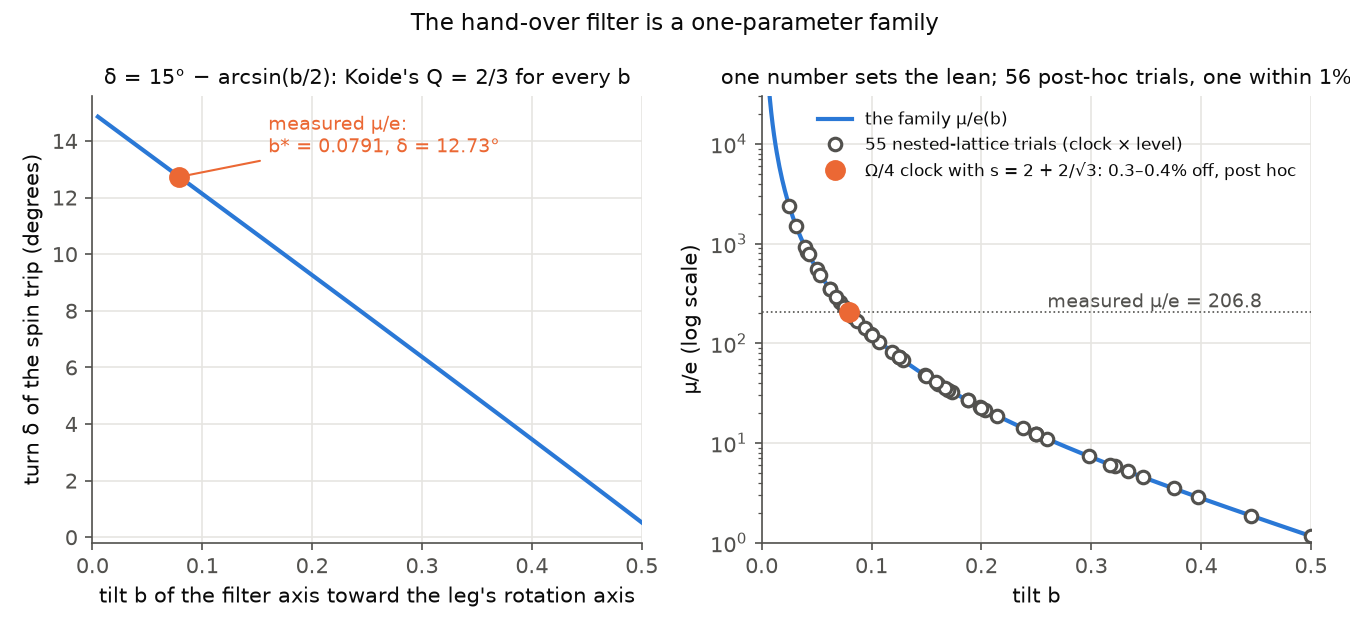
Figure 1. Left: the turn δ against the filter’s tilt b; Koide’s relation holds for every point on the line, and the measured μ/e picks b = 0.0791. Right: μ/e against b on a log scale, with the 56 nested-lattice combinations (clock × nesting level) marked; one lands within 1%, the Ω/4 clock with the level factor 2 + 2/√3, seen before it was locked and so a lead, not a hit.*
2.4 The nested-lattice reading: a lead, not a hit [P, post hoc, checked]
Doug asked whether U44’s nested lattice could supply the ratio. If the hand-over clock is Aspden’s quiet photon-unit rate Ω/4 and ω₀ is the first nested level’s rhythm sΩ, the ratio is 4s, and s = 3.15 is U44’s body-centred factor 2 + 2/√3 = 3.1547. Of 56 combinations (8 clocks × 7 factors), that one gives μ/e within 1%: 206.11 (−0.32%) with the tilt read as tan θ, 207.55 (+0.38%) with the dressed state’s own sin θ, so the 0.3% level carries no information, and π is as close as 2 + 2/√3. The coincidence was noticed before the lock was written, and the lock’s own times could not be shown to precede the run. Chance gives one such match in 56 trials about half the time by the lock’s rule, 15% by a stricter count. It is a post-hoc lead with three things for it (no fitted number; Aspden’s quiet rate; U44’s own geometry) and three against (0.3% is 10⁵σ at the measured precision; the level-1 cube is pushed off its sites by the big lattice’s field; the projection and probability conservation are ours). Two of the three supports are weaker than first written: the quiet Ω/4 rate is the 1969 and 1980 rule only, and the dressed-state projection is ours [P]. If pursued, it must first predict something it was not built from: the lepton’s clock at Ω/4 and a nested spacing of d/3.155, both with consequences elsewhere.
2.5 Aspden’s own rule against the cube [A applied by us, checked]
In Physics without Einstein (1969, ch. 4, read at source) and, by the project’s source digest, Physics Unified (1980, ch. 5; not yet re-read at source) a photon unit turning at exactly Ω/4 radiates nothing, and at any other rate it radiates at four times the offset; his 1997 Tutorial Note states the rule with the absolute rate and names no quiet rate. Every cube rate that brings the lepton masses within reach radiates hard X-rays by the 1969 rule (figure 2): 256 keV at spin ħ/2, 73 keV with corners at c/2, 83 keV at the rate a hit would need, 154 keV for the edge-axis near-miss. The only quiet rate, Ω/4, gives μ/e about 455. So, under the postulate that holds the cube’s rate, a stable electron cannot be a photon cube. The tension is between Aspden’s photon rule and our cube models; his own electron is not a cube.
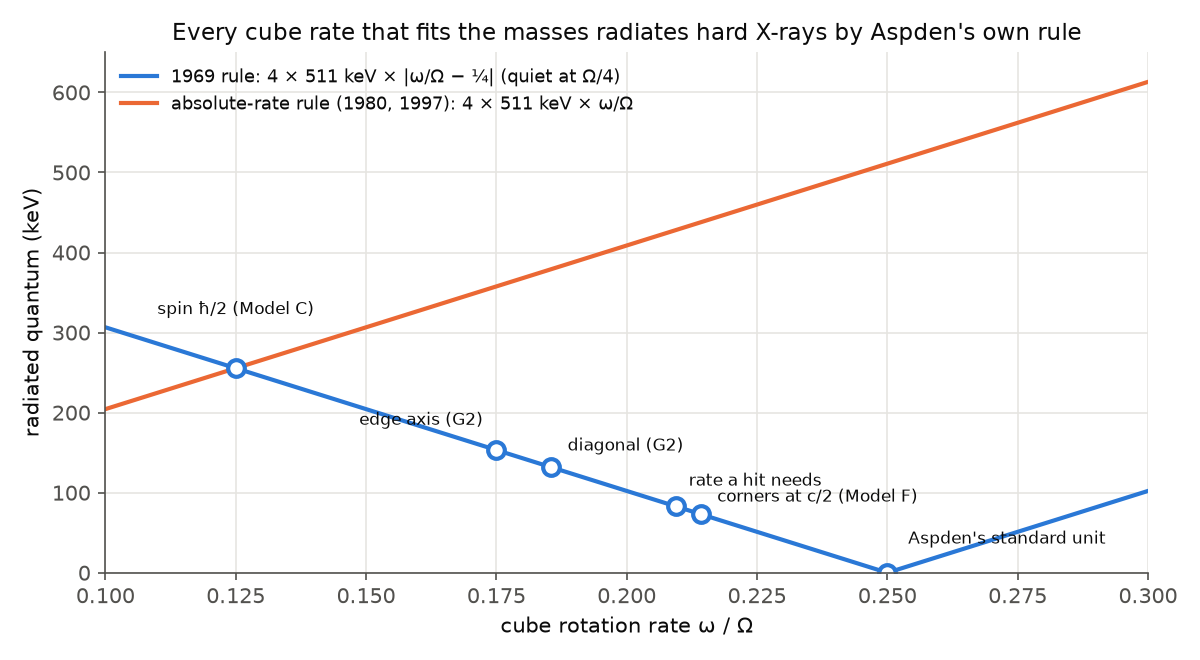
Figure 2. The quantum a photon cube radiates against its rotation rate, by Aspden’s 1969 offset rule (quiet at Ω/4) and by the absolute-rate form of 1980 and 1997, under which the 1997 note names no quiet rate (the 1980 text keeps Ω/4 quiet by a separate argument). The cube rates the lepton models used are marked on the 1969 line.
2.6 Since the morning: the muon sea’s drag, and the simulator’s first number [D and P; stage 0 Fable-checked; Model H Opus-checked, post hoc]
Model H, the muon sea’s induced drag (Doug’s idea, run in his cloud session between 09:25 and 10:21 EST; U46 step 7g). If the virtual muon pairs of Aspden’s sea (one pair per lattice cell [A]) are renewed faster than the cube’s motions, each takes a fresh momentum kick at every pass and drags the precessing cube like a cold plasma; that is close to the most drag a cold sea can give, an upper bound to within a factor of order one. The bend it supplies, as a fraction of the leg’s carrying rate, comes out at 0.0006 to 0.0012 with corners at c/2 (0.0015 at the ħ/2 rate by the drag law) against the 0.0084 that would close F1’s 4.7% gap: 7 to 14 times too weak (5.6 at the ħ/2 rate), and long-lived muons give almost none. A corollary holds whatever the medium: Koide’s precision fixes the trip’s corners at right angles to within 0.003°; the bend found moves them by 0.1°, thirty to forty times that, and one big enough to matter would move them by about 1°, so something else would have to put them back. Checked by an Opus agent in the cloud session, not a Fable agent as the morning’s rule asks; its lock reached git after its runs, so by the commit rule it counts as post hoc.
The full-dynamics simulator, stage 0 (locked and committed 09:09 EST, run 09:31–12:47, checked by a Fable agent 13:06–13:43; Fullsim_stage0_2026-11-02.md). The simulator Doug asked for this morning, with every force switchable and the cube and a point spin as carriers, exists in its first stage and passed five of its seven locked acceptance tests. The two fails teach more than the passes; what follows reads them after the fact and is post hoc. First, a 30-trip run of Model F2 (the cube with C’s clock) is chaotic: the night’s own code, run again on isla, agrees with itself to 10⁻¹⁵ but drifts from the cloud machine’s saved trips by a factor of three per trip, so after twenty trips the two machines’ trips simply differ; their averages agree at the 0.003 rad level, on little evidence (most trips are identical and only the last few of two runs differ), and averages are Doug’s method anyway. Second, the slot precession, measured with the dynamics instead of estimated from the averaged push: with the static Coulomb push alone the spin precesses about its slot at 1.03 times the leg rate at the ħ/2 rate and 0.43 with corners at c/2, clockwise seen from the slot. The outline’s estimate (3.1 and 1.06) had used the lattice-aligned cube, the wrong one; the face-axis cube’s averaged push gives 1.76 and 0.60, and the dynamics give less than that because the cube’s face axis cannot follow a spin axis that precesses as fast as the cube spins (a first-order theory derived in the check after the result, ω₀ = −(√(1 + 4 tff V″) − 1)/2, fits within 2% at and below the c/2 rate and 11% at the ħ/2 rate). The averaged push is recovered as the slow limit, 0.93 of it at a thirtieth of the ħ/2 torque factor (figure 6). For the one open number of §2.3 two things follow: the static push appears to have the sign the dressed state needs (a negative precession about the slot axis, which Filter_check §7 asked for; a reading made after the run, to be confirmed in stage 1’s lock before anything rests on it) but is 12 to 29 times too small, against the “4 to 12” estimated in the morning. Stage 1 (the other forces as maps) and stage 2 (their full dynamics) come next.
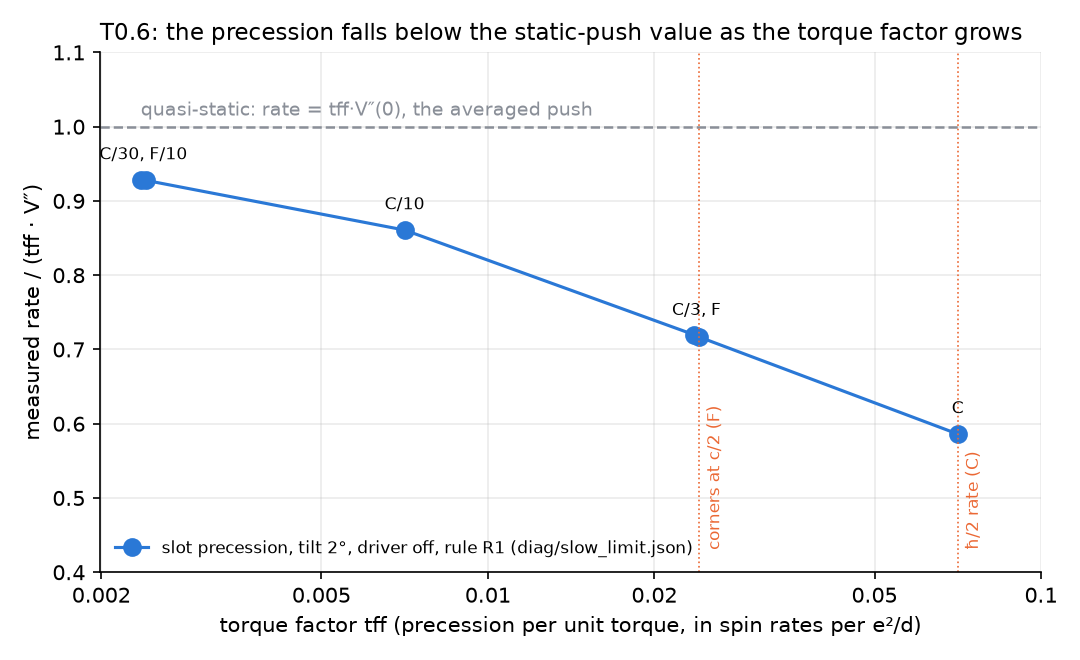
Figure 6 (numbered in the order of addition; figures 3–5 are in §3). Stage 0 of the simulator: the spin’s precession rate about its slot under the static push, divided by the averaged-push (quasi-static) value, against the torque factor. At the two rates the models use (dotted lines) the dynamics give 0.59 and 0.72 of the averaged push; at a thirtieth of the ħ/2 torque factor, 0.93. Source: sim/lepton/fullsim/fig_stage0.py.
3. Light
3.1 Why the lattice as left cannot carry light [D, from Part 1 and 1B]
Treated with Coulomb’s and Maxwell’s laws, a lattice of charges held only by its own field is a plasma at the Compton frequency: nothing below 511 keV travels. With Aspden’s spring it is a dielectric whose dispersion is one and a half million times the measured bound. And a lattice wave cannot be shorter than the lattice, while a 511 keV photon is 3.8 lattice spacings long, a 31 GeV photon one sixteen-thousandth of a spacing, and the gamma-ray burst GRB 090510 delivered 31 GeV and 0.1 MeV photons together to two parts in 10¹⁸ after seven billion years. Whatever carries light in the aether, it is not the lattice’s motion. Three routes remained.
3.2 R2: light as a phase wave of the circling [P, D, checked]
Aspden’s quons all circle in step at Ω. Let the phase of the circling vary from cell to cell and ask whether that ripple travels, and at what speed. With each quon on a rigid circle of radius r about its site (a bead on a ring, our most permissive reading) and Coulomb forces between quons, the ripple’s restoring force is half the energy of two dipoles e·r along the circling axis, summed over the lattice with Ewald’s method, and the fast term at twice the circling frequency was kept and treated exactly (a Floquet analysis). The long-wave limit is exact: ω²/Ω² → 1/12 − ¼cos²θ, where θ is the angle of the ripple’s wavevector to the circling axis (figures 3 and 4).
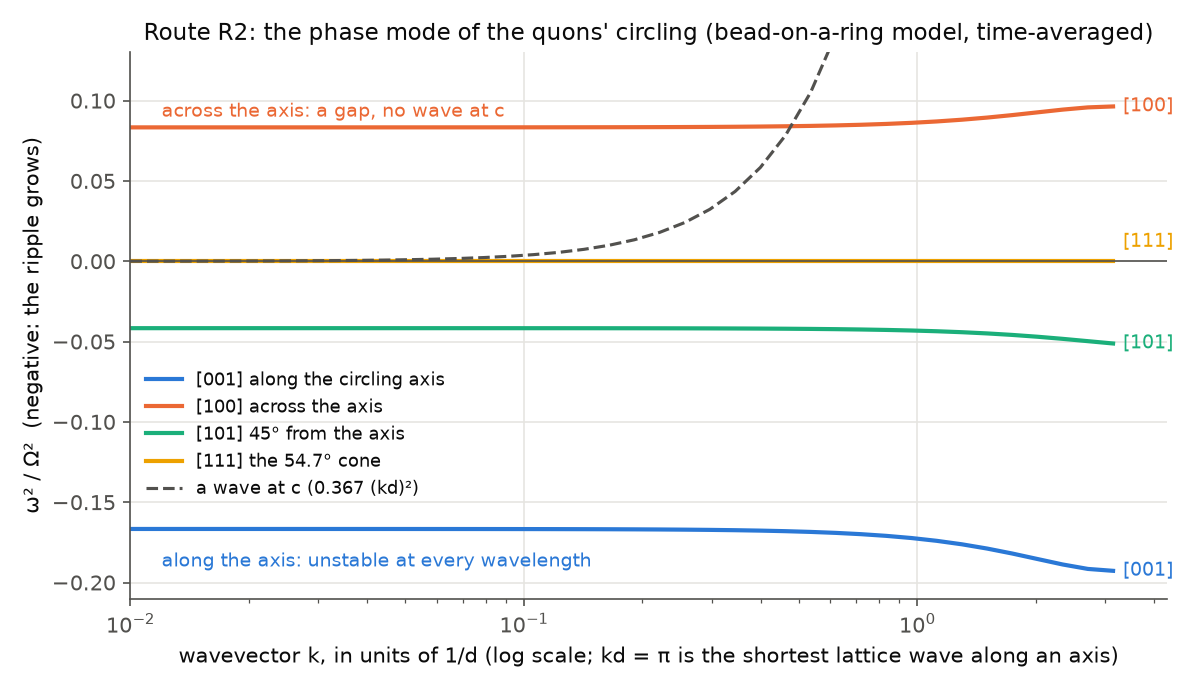
Figure 3. ω²/Ω² of the phase ripple against its wavevector, in four directions, with the line a wave at c would follow. Along the circling axis the value is negative at every wavelength: the ripple grows. Across the axis it sits on a gap (0.29 Ω in the time-averaged equation plotted here; 0.30 Ω, 155 keV, with the fast term) and hardly moves. Along [111], on the 54.7° cone, it is zero by symmetry. Nothing follows the light line.
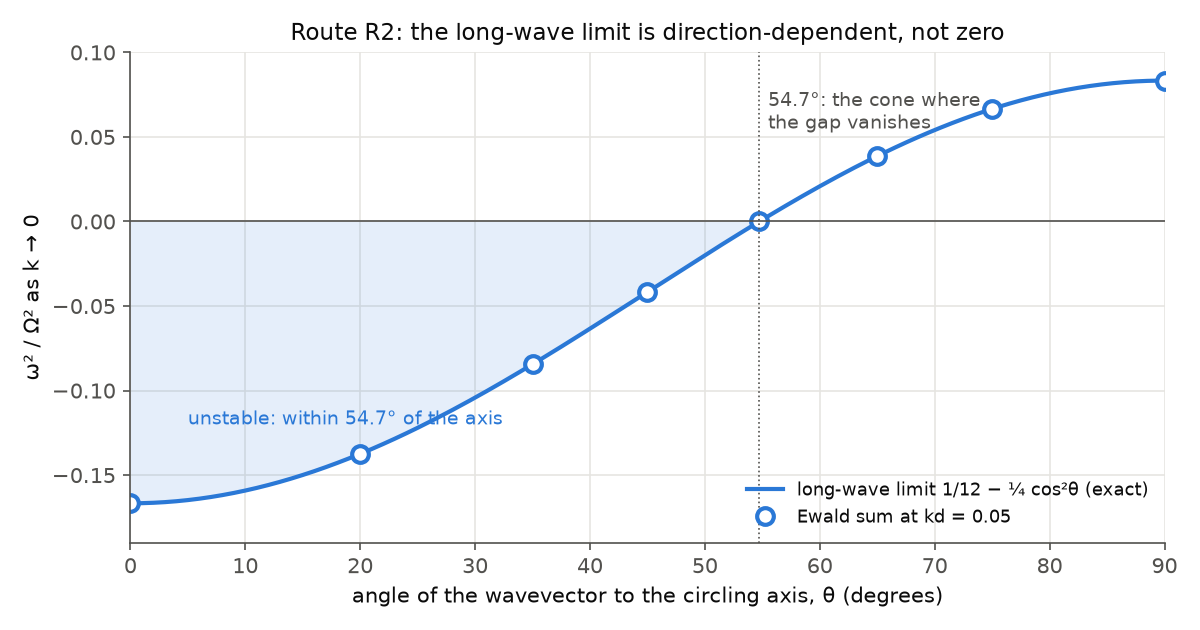
Figure 4. The long-wave limit 1/12 − ¼cos²θ, with the Ewald sums at kd = 0.05 on top of it. Every direction within 54.7° of the circling axis is unstable.
What it says: under this model the synchronous circling is unstable to phase ripples stacked along its axis, fastest for adjacent layers in antiphase, with an e-folding in about a third of a turn. Coulomb forces between the quons do not hold Aspden’s synchronism; along the axis they work against it. Across the axis the mode is gapped and nearly dispersionless; along the cone it has no stiffness at all. No branch travels at c in any direction, and light’s speed is isotropic to a part in 10¹⁸. Under Aspden’s own isochronous orbit the phase is not even a slow coordinate: a slow torque on the phase changes the orbit’s radius and leaves the phase alone, so a “phase wave” is only the beat of the lattice’s ordinary waves against Ω. R2 is closed under both readings. The independent check reproduced every number with its own code and found one slip, a factor 7.4 in the light line, which changed no conclusion.
3.3 R3: the continuum or the muon sea as the medium [P, D, checked]
The continuum is continuous, so the shortest-wavelength objection does not apply. As a charged fluid against the lattice it is a plasma, with a cutoff at 361 keV (the continuum alone) or 511 keV (both frames): the same failure as the lattice’s. As an elastic medium, Aspden’s muon sea (210.9 MeV per cell, an energy density of 1.3 × 10²⁶ J/m³) carries transverse waves at c only if its shear modulus equals that energy density, 1.3 × 10²⁶ Pa, which is 7,400 times the only stiffness in the theory and is not in Aspden: a fluid of virtual pairs has no shear modulus at all. So R3 can only restate v = c as a property of the sea, which is R1 for the transverse wave. The same mechanics also gives such a sea a longitudinal wave faster than light unless it is unstable to compression, the objection that ended the elastic-solid aethers of the 1830s (the check’s addition). A medium with no preferred frame carries no transverse elastic wave at a finite speed; one with a rest frame and that stiffness is Lorentz’s aether for the transverse wave, with a longitudinal wave and a rest frame that R1 does not have. The check reproduced every number and corrected one phrase (two million, not a billion).
3.4 R1: light as the field, the lattice transparent [P, D, checked]
R1 keeps the quon lattice, the graviton balance and the muon sea, and makes light Maxwell’s field at c, with the lattice transparent to it: the lattice sets the constants but does not enact the wave. Three cheap checks:
- Consistency. Aspden’s chain of units (POC 7.1–7.29: r, d, m₀, N = 1843, α, E₀) uses the quons’ own fields, the continuum’s field on the displaced lattice and the quantization of the photon unit, and nowhere a response of the quons to an external field. A transparent lattice keeps α, mₚ/mₑ, the hadron numbers, G and E₀ exactly as they stand. The photon unit must stay as the quantum of emission and absorption, exchanged only at matter.
- How transparent. If the quons did respond, GRB 090510’s timing requires an orbit held against the field with a stiffness at least 7 × 10¹³ times the continuum’s own (an internal mode above 3 TeV), or a coupling below 1.3 × 10⁻¹⁰ of e; the photon-mass limit pushes the coupling below 3 × 10⁻²⁴. The lattice’s response is then below 1.5 × 10⁻¹⁴ of ε₀ (figure 5). So “the lattice is the vacuum’s permittivity” cannot be a statement about its response: if the lattice sets α it does so through its geometry and the unit’s ħ, and c is an input to its chain.
- Static screening. The hydrogen Lamb shift bounds any screening of a charge by the lattice at the scale r to below five parts in 10⁷; a lattice meeting the GRB floor passes by seven orders, and the response reading of ε₀ is excluded a second time, by two million.
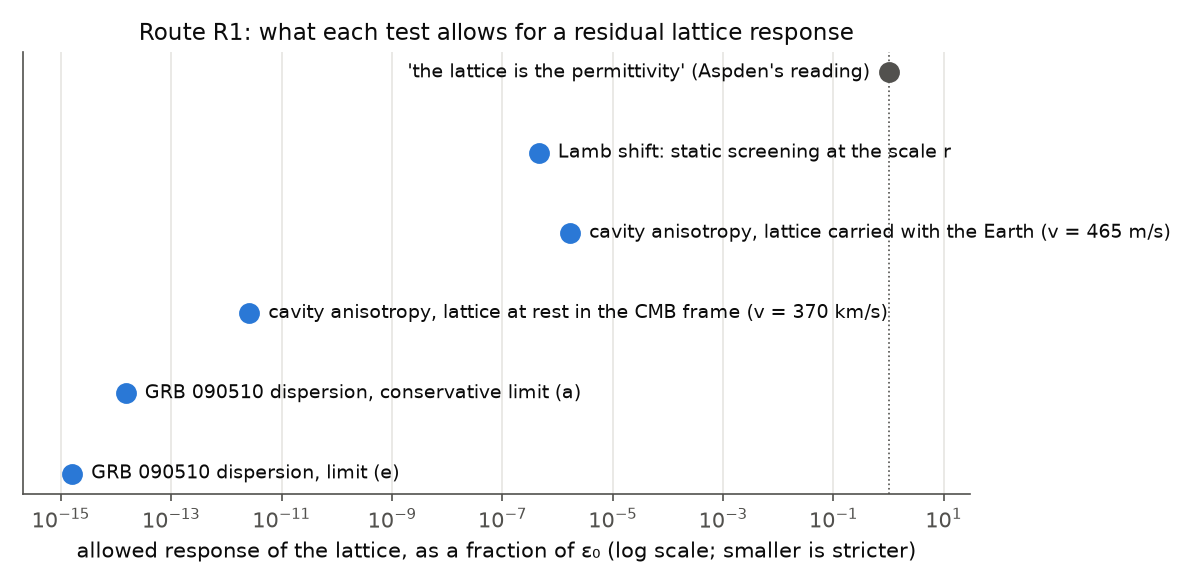
Figure 5. The largest lattice response to a field each test allows, as a fraction of ε₀, on a log scale. The gamma-ray-burst dispersion sets the floor; the cavity tests and the Lamb shift are weaker, and Aspden’s reading of the lattice as the whole permittivity sits at 1. The Lamb-shift point bounds static screening, which the stiff-orbit model ties to the same response.
What R1 has to mean: a two-sector electrodynamics, Aspden’s 1987b rule (“the aether’s charge belongs to the electromagnetic reference frame and makes no field”) made exact, with the aether’s charge coupling to the aether’s own fields and to matter only through the quantized units, and sorting by the kind of motion (a unit set turning radiates; a collective displacement does not). Nothing in the chain forbids it; nothing in the chain explains it. It replaces Aspden’s own account of light (the 1969 dispersion formula, the resonance picture, the Earth-carried frame) and needs Lorentz’s kinematics for the lattice’s rest frame to stay hidden, which Aspden refused. The independent check reproduced the audit and the floor, and corrected two formulas (the cavity anisotropy and the sign of the plasma bound) without changing a conclusion.
4. The branches that did not work out
| Branch | Why it failed | Where |
|---|---|---|
| Model L: light as a bump passed from quon to quon | 0.2–0.3 c, anisotropic, lattice unstable; no variant reaches c | HANDOFF §3 |
| The lattice as a dielectric or plasma (Part 1B) | cutoff at 511 keV; dispersion 10⁶ times the bound | Part 1B |
| Mechanisms A, B, C, C′, C″, E, F, G, G2 for the lean | the push is the wrong size: from 0.6% short (the edge axis) and 4.5% short (F) to 3 times too far (C) and 19 times too weak (B); or the carrier loses the trip’s corners (C″, E0); A changes the hand-over’s size, never its phase | U46, L2_solution_search_results |
| The edge-axis cube (209.7) | 1.4% high, robust; its corners are not on L1’s √2 circle; radiates 154 keV by Aspden’s rule | U46 7f |
| The dressed state as the whole filter | right direction, wrong size: Koide 102σ off | Filter_check §7 |
| The nested lattice as the source of the ratio | post hoc, one of 56, convention-dependent at 0.3% | Filter_check §8 |
| The nested lattice as a ladder for light | a photon sits at kd = 1.65 on every level; the GRB bound needs kd below 5 × 10⁻⁹: only the continuum limit works | Filter_check §8 |
| R2, light as a phase wave | unstable along the axis, gapped across, soft on the cone; no slow phase mode under Aspden’s own orbit | Phase_wave_R2 |
| R3, the continuum or muon sea as the medium | a plasma again, or a postulated stiffness equal to the energy density, which also brings a longitudinal wave above c | R3_continuum |
| Model H: the muon sea’s induced drag on the cube | 7–14 times too weak even at its most dissipative; long-lived muons give almost none; any dissipative bend that mattered would break Koide’s corners | U46 7g |
| The static push as the whole source of the precession (simulator stage 0) | the sign that looks right (to be confirmed), 12–29 times too small; the morning’s averaged-push estimate was itself 2–3 times too high (a post-hoc reading of the failed test: wrong cube, and the fast-top picture fails) | Fullsim_stage0 |
| Shrinking or stiffening the lattice (R4) | breaks r = ħ/2mₑc and α | Improvement_directions §4 |
| Aspden’s Earth-carried frame | excluded through the Earth’s rotation by 1,500 | Part 1 |
| Water at 10 m and 1000 m (the sound analogue) | done to about 1%, paused: its one lesson for light is the shortest-wavelength limit | HANDOFF §0 |
5. Predictions and tests
| What | Predicts or requires | Against | Status |
|---|---|---|---|
| Model L1 with the measured μ/e | m_τ = 1776.97 MeV | PDG 1776.93 ± 0.09 (+0.4σ); Belle II 1777.09 ± 0.14 (−0.9σ) | passes; unchanged by the filter |
| the filter family | Koide’s Q = 2/3 exactly | 0.6666645 ± 0.0000051 (+0.4σ) | passes; the same test as the tau’s, seen through Q |
| the same filter for the neutrinos (Brannen’s rule, an added assumption) | Δm²₂₁/Δm²₃₁ = 0.03084; Δm²₂₁ = 7.81 (IC19 scale) or 7.75 (IC24) × 10⁻⁵ eV² | NuFIT 6.0 (copied, not re-read at source): +2.3σ / +1.9σ; JUNO 2025 (read at source): +2.6σ / +2.1σ | 2σ off; the next JUNO release decides |
| the dressed-state reading | the hand-over’s rotation sense is opposite to the leg’s, or the spin precesses the other way; ω₀/ω_leg = 12.6 | the static push alone gives the precession in what looks like the right sense and 1.03 (ħ/2 rate) or 0.43 (corners at c/2) (simulator stage 0) | the one open number: the sign appears to be there (to be confirmed in stage 1’s lock), the size is 12–29 times short |
| the nested lead, if pursued | the lepton’s clock at Ω/4; a nested spacing d/3.155 with its own field on matter | not yet pre-registered | lead only |
| a stable electron as a photon cube | radiates 73–256 keV by Aspden’s 1969 rule (256–438 keV by his absolute-rate rule) | stable electrons | fails under the fixed-rate postulate |
| R1: the lattice’s response to light | below 1.5 × 10⁻¹⁴ of ε₀ (stiff orbit) or 10⁻³⁹ to 10⁻⁴⁷ (weak coupling) | GRB 090510, photon-mass limits | a requirement, met by construction |
| R1: static screening at the scale r | below 5 × 10⁻⁷ | hydrogen Lamb shift | met by seven orders |
| R1: muonic hydrogen | a screening at the scale r shifts its Lamb shift by 228 eV per unit screening | electronic and muonic proton radii agree to 0.01 fm, giving δ < 2.5 × 10⁻⁷ as a rough first estimate (the check’s) | a cheap next test; not a result until it has its own lock |
| R1: the hidden rest frame | cavities, the CMB dipole and the Earth’s rotation see nothing | Nagel et al. 2015 bound a residual at 10⁻¹² (CMB frame) | consistent |
6. Next steps, in the order proposed
- The lepton’s one number. Pre-register a mechanism for ω₀/ω_leg = 12.6 with the sign the dressed state needs, and a reason the hand-over conserves its probability; count every trial. The chiral term from the lattice’s circling is the one ingredient every L2 model left out and the only one with the right handedness; its direction test is settled by symmetry (the hand-over’s rotation axis must be the local circling axis). The simulator’s stage 0 (§2.6) has now measured what the static push alone gives: what looks like the right sign (to be confirmed in stage 1’s lock) and 1/12 to 1/29 of the size. Stage 1 maps the other forces (the continuum, the lattice’s circling and its magnetic field, the spin’s own couplings) as pushes, and stage 2 runs their full dynamics, each stage locked and committed before its run and checked before it is quoted.
- R1 as equations. Does Aspden’s 1987b text give the two-sector coupling in a form that can be written down, with the same e²/ε₀ in both sectors? That is the question Part 1B §11 left open, and it is now the whole light question.
- The photon unit as the quantum. What does a 27-quon cube that takes up ħ and hν at the emitter predict that QED does not, at second order in its size (1.9 × 10⁻¹² m), against the Lamb shift or the electron’s g − 2?
- Muonic hydrogen as the direct probe of the scale r: a locked calculation with the full profile and both hydrogen systems.
- Reviews. Round 1 (Copilot, Qwen, the blind Claude) is frozen until their reports are in; the blind Claude’s full-dynamics run differs from the package’s F2/F3 and must be reconciled. Round 2 sends the filter work to Qwen.
- The website. This page is published as deployment 14 at Doug’s request, with the stage-0 page, four technical pages as Markdown files and seven figures (site/deploy14/apply-14.sh); the three route pages as website pages, and a paragraph each in the working paper’s light section (§§13–14) and Part 1B §11 pointing here, are still to do.
7. How the work was done
- Every mechanism was locked before it was computed, with its expected result, except where this page says otherwise (C′, D, the first dressed-state reading), and from this morning on a lock counts as pre-registered only if it was committed to git before its run. Two locks from before this rule could not be shown pre-run from the record: lock part N (the nested reading, post hoc anyway by its own disclosure) and the G2 section (the cube’s body axis, including the edge-axis near-miss), whose pre-run standing rests on the author’s word and on its three expectations having been wrong. Both are labelled.
- Every result, hit or miss, is reported, and the trials are counted (27 lattice trials and 56 nested combinations so far; a 1% window is hit by luck about once in 80 trials).
- Model H (§2.6) was produced and checked in Doug’s cloud session with an Opus checker and reached git after its runs; it is labelled post hoc and Opus-checked. The simulator’s stage 0 was checked by a Fable agent that reproduced every number it could recompute with its own code (its own Ewald sum, integrator and reducer; the two longest runs were checked from their files and against the theory); its two Major findings were a wrong growth rate in a disclosure and one wrong sentence about the precession per leg, both corrected (Fullsim_stage0 §8). Stage 0 took three attempts (the first hung on a Python 3.14 pool bug), and every code change made after seeing results is listed in its lock.
- Every page was checked by an independent agent with its own code before it reached Doug (Fable for everything from the solution search on, except Model H; Opus for U46 steps 1–7e, Model H and the earlier papers), and this page’s afternoon additions by a second Fable check (Summary_check_2026-11-02_b.md) before publication; the checks found and corrected: two reporting errors in the F2/F3 statistics; five labels in the solution search; the TU08 attribution and the quark hand-over sizes in the filter page; the inverted light line in R2; the cavity formula and the sign of the plasma bound in R1; a “billion” that was two million in R3; and on this page itself, the checking attribution, a wrong range of misses, the count of unprovable locks and a dozen caveats (Summary_check_2026-11-02.md). None changed a conclusion.
- Times are labelled from isla’s clock in EST; several time labels written as estimates ahead of the clock were caught and corrected.
8. Reproduction
From sim/lepton: filter_check.py, filter_check_dressed.py, nested_filter.py, model_G1.py, model_G2.py, model_G2_conv.py, b_radius.py, f1_extrap.py, b_circling.py, model_F2_summary.py, phase_wave.py, phase_wave_post.py; from sim/light: r1_checks.py, r3_continuum.py, fig_summary.py; from sim/lepton_photon: neutrino_juno.py, koide_predictions.py; for the mechanisms A–F of §2.2: mechA_thomas.py, lattice_push.py, lattice_push_C_grid.py, c_scale_target.py, model_C2.py, model_E0.py, model_E1.py, model_E2.py, wobble_koide_bound.py, model_F1.py, model_F2.py (with ringpush.py, which the G scripts import). For §2.6: from sim/lepton/model_H, model_H1.py, model_H1_sens.py, sign_check.py and drag_target.py; from sim/lepton/fullsim, run_stage0.py (with fields.py, carriers.py, trip.py and reduce.py), the diagnostics in diag/ and fig_stage0.py. The check reports are in sim/lepton/lepton_check (to lepton_check5, the Opus checks of U46), lepton_check6, lepton_check7, lepton_check8, sim/light/r1_check_fable, r3_check_fable, sim/lepton/model_H/lepton_check_H (Opus) and sim/lepton/fullsim/check_fable; this page’s own check is papers/Summary_check_2026-11-02.md. All need numpy, scipy and matplotlib only.